APTA Board Member – Sara Lanthier

Sara Lanthier

Residence: Toronto, Ontario

Occupation: Contributing writer at UrbanMoms.ca and social media specialist at Corns Entertainment

Years of Service on the APTA Board: Two

Family: Son Will (5), APTA National Champ 2033

Years Playing: I started when I was 10. So *cough, cough* 18? Okay, 34 years!

How did you get started playing platform tennis? Our family moved to London, Ontario, where they had one in-ground court. We started playing and taking train trips to Toronto to play the “big city” kids in tournaments. A few years later we moved to Toronto and chose to live where we did because of the ties we had already made with the platform tennis players there.

Contribution to the APTA Board/Contribution to the platform
tennis community.
My unofficial goal with the APTA is to get the name changed to NAPTA (North American Platform Tennis Association). Canada needs some representing and it has a nice ring. But my official role is with the Communications Committee, specifically to connect players and enhance the sport’s recognition through social/new media.

Favorite playing or fan moments. My most infamous on-court moment was faulting one game away, four in a row, in the semis at Shadow Lake. We won the match and my sister/partner was still talking to me, so it all turned out okay in the end. My most memorable moment was in the consolation semis at the Chicago Nationals where my Achilles tendon decided to snap. I was casted, drugged, and back in the stands watching, beer in hand, within three hours. Reality set in the next morning but I enjoyed the afternoon, at least. My number one fan moment is easy. 2005 Pittsburgh Nationals. Watching Mike Stulac and Billy Anderson come back from a 6-0, 3-0, deficit to win the finals. Incredible! Sorry, Mike Cochrane and Mike Marino, but I will remember that match forever.

Past/future endeavors not platform tennis-related. My son has made a list of 20 spots (and growing) around the world that he wants to visit. I’m hoping to take a sabbatical when he’s ready to travel the world and show him all there is to see. This will, of course, be from April – October, unless we’ve grown the game globally by then.

Favorite quote. The last time I was asked for a favorite quote, I chose one from Axl Rose. I think I’ve grown up since then. Two years ago, the sitting leader of one of Canada’s political parties, Jack Layton, died of cancer and left a letter to Canadians saying goodbye. He ended with this quote which hangs on my desk: My friends, love is better than anger. Hope is better than fear. Optimism is better than despair. So let us be loving, hopeful and optimistic. And we’ll change the world.

Source: Platform Tennis Magazine, Vol. 15, Issue 1 Sept./Oct. 2013

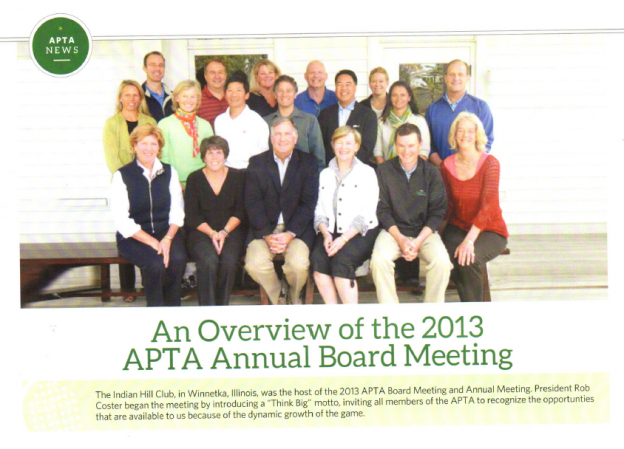
APTA Annual Board Meeting Overview

Hellos and Goodbyes The board welcomed four new members and said farewell to three whose terms expired. The APTA membership elected in David Lee, Region II, Shannon Vinson, Region V, Nathan LeFevre, Region VI, and Freddy Goldenberg, Region VII. Juan Martinez-Arraya, Tina Kelly, and Peter Lauer will be missed. Arraya brought great energy and dedication to the Clinics and Exhibitions Committee. Kelly’s savvy marketing, writing and editing skills were invaluable for all APTA communications. And Lauer, head farmer for six years of the Grow the Game initiative, boosted a good program into a great program.

Financials Alia Main reported that the APTA is in excellent financial health at this time. Revenues continued to increase.[Note: The 2013 990 Form Filing shows that the net assets of the APTA were in excess of $500k, an all-time high]

Sponsorship/Branding Viking has deepened its commitment to the sport. They will now be the title sponsor for Clinics and Exhibitions, the Junior Tour, and the President’s Cup, and will continue to provide the balls for all APTA National Championships.

Grow the Game One of the largest financial commitments of the APTA is the ‘Grow the Game’ initiative. In its seventh season, this program offers grants and loans to new clubs for construction, as well as to established clubs for repairing facilities. Forty inquiries were received this year. (see Grow the Game .)

Gifting Under the leadership of David Lee, this group is searching for ways to create an endowment that would provide the APTA with a long-term source of capital to fund growth initiatives and other capital projects.

Hall of Fame Steve Baird has been elected the new chair of the Hall of Fame Nominating Committee. Bob Brown is retiring from the post. On a side note, the Platform Tennis Museum and Hall of Fame website — run independently of the APTA — offers a wonderful pictorial and historical look at the game.

Exhibitions and Clinics Nathan LeFevre, the youngest board member and a nationally-ranked player, is heading up the Exhibition and Clinics Committee. Last year, the APTA sponsored seven clinics around the country. This year’s clinics and exhibitions will be held in Newark, Delaware; Glenview, Illinois; York, Maine; Chevy Chase and Baltimore, Maryland; South Orange, New Jersey; Charlotte, North Carolina; Columbus, Ohio; and Charleston, South Carolina. PPTA The professionals in the sport of platform tennis scheduled a conference for early September. The organization plans to organize a junior training camp in the future.

Juniors The Junior Tour/College Development Committee, chaired by Steve Caccam, has approved new age groups for the upcoming season. The new groups are: 10 & Under; 12 & Under; 15 & Under; and 18 & Under. (For more clarification, go to Junior News in in this issue.) Also, the APTA has created the post of Junior Tour Coordinator to assist the various tournament directors around the country to increase junior participation. And, starting this year, the board has approved a budget item that offers the Boys’ and Girls’ 18 & Under Junior Nationals Champions free entry into the Men’s and Women’s Nationals. (Last year, an anonymous donor paid for the teams.)

Membership APTA Membership numbers increased by over 1,000 in 2012-2013. Many leagues, including Chicago and Rochester, increased their memberships. A record number of clubs (230) joined this year. The database now lists 505 platform tennis facilities in North America. The member club gift—Passing Shots: A Pictorial History of Platform Tennis—was approved and will be sent out this fall.

Equipment and Rules Fritz Odenbach introduced two new ball manufacturers, Bounce and Rhino. Both balls have been approved by the APTA. Standards for low bounce balls will be established and posted on the APTA website. Let cord and foot fault rules are being reviewed. The committee approved trial Wheelchair Platform Tennis rules. (See Don Godshaw and wheelchair paddle.)

League Dashboard/Social Media The heavily anticipated My APTA page was demonstrated by John Noble and Isabel Cabanne at the meeting. The software is still under construction but is expected to be completed this fall. The APTA and the Chicago league have invested a great deal of time and money into this venture, which will provide additional benefits to member leagues. Connecting creatively with the APTA membership is one of the key goals of the Social Media group. The APTA Facebook page displays fun and current information. Region II and Region IV have impressive Facebook presence, too.

Courts and Building Rob Coster excitedly discussed how demand is exceeding supply. Many new courts are at public facilities or in areas that didn’t previously have paddle. Texas, Oregon, and Washington are now first-time parents of new courts, much to the delight of Hendy Dayton and Region VI. An estimated 66 requests for new courts have been submitted to the court builders. Hut design has now become a routine part of their service. Every new facility receives an APTA welcome package. Viking provides a case of balls and four paddles to get programs up and moving. On a side note, a new composite surface is being tested that that may help eliminate “footlock.”

Awards The 2013 APTA Service Awards will be announced this fall. Because of the enormous number of deserving candidates, the Service Award will be given to multiple commendable contributors.

Tournament News There is a great deal of moving and shaking in the Nationals Tournament schedule. See below for the updates. A new Tournament Task Force Committee has been formed to provide additional guidance to directors of all levels of tournaments

Source: Platform Tennis Magazine, Vol. 15, Issue 1 Sept./Oct. 2013

APTA Board Member Profile – John Noble

John Y. Noble
Residence: Lake Forest, Illinois. John Noble was born in Berkeley, California, grew up in Lake Forest, and graduated from Lake Forest High School and Ball State University.
Occupation: Noble works, as an Owner and Vice President of Sales, with his brother in a unique healthcare company—PathFinder Health LLC—that focuses on connecting people with doctors, so that more people can engage and follow through to improve their health.
Family: He has three beautiful daughters, Susanna, Sarah and Catherine, and a wonderful wife, Susan, who has been and continues to be of great support. Tennis and service have been major influences in his life; his grandfather presided over the Westerns for many years and his father served as president of the Chicago District Tennis Association.

Getting into the game: Being friends with a good number of the Chicago-area tennis pros, who taught paddle, allowed for ample opportunity to learn the sport. Noble began playing platform tennis in 1999 and quickly became addicted and participated whenever and wherever he could.

Contribution to the APTA Board: Noble is on his second term on the board. He heads the Technology Committee, where he creates opportunities to bring the sport and the association into the 21st century. He introduced the Live Scoring system with Isabel Cabanne several years ago and has been working to bring a new player/league rating system to the APTA. Recently, a new Streaming concept has been introduced, and Noble was the mastermind behind the new “Paddle Night In America,” with the hope of having a dedicated Platform Tennis Channel online. The Technology Committee is also near completion on the APTA Dashboard. Additionally, Noble serves on the APTA Men’s Ranking & Tournament Committee (since 2004) as the Region V representative.

Contribution to the platform tennis community: While living in Evanston, he was introduced to the Chicago League and Alan Graham. It did not take him long to volunteer one too many times, and so, in 2002, began his time running the Chicago Charities and as Director of Tournaments for the Chicago Platform Tennis Charities League (CPTC). With the Chicago league support and a strong volunteer network, Noble has continued chairing the Charities along with many other Chicago paddle tournaments since then. He helped chair the 2011 Men’s and Woman’s APTA Nationals and 2012 Mixed APTA Nationals in Chicago and will be chairing the upcoming 2014 APTA Men’s 45+/55+/65+ Nationals as well as the 2015 and 2020 APTA Men’s and Women’s Nationals.

On-the-court accomplishments: Noble has played on the Region V President’s Cup team over ten times, including three championships, and was the winner of the 2012 Illinois State Platform Tennis Championships with Peter Berka, and runner-up in 2013. With strong support from Rod Workman, the pair won both the 2011 and 2012 Chicago Charities 90+ tournament. Noble’s highest APTA ranking has been 16 during the 2012-13 season with Mike Rahaley. Currently, they are ranked in the top 20 this season.

Off-the-court accomplishments: Noble was inducted into the Ball State University Athletic Hall of Fame in 2009 for tennis. He played tennis professionally for two years, and coached at his high school for five years. In a completely different arena, Noble is a two-time Tony Award winner; for Best Revival of a Play (2001) for One Flew Over the Cuckoo’s Nest starring Gary Sinese, and for Best New Musical (2002) for Thoroughly Modern Mille.

Source: Platform Tennis Magazine, Vol. 15, Issue 3 Jan/Feb 2014

APTA Volunteer of the Month – Barry Snyder

Many years ago, a young Delaware lawyer, Barry Snyder, made a discovery far more momentous than any legal writ: Paddle is a lot more fun than most racquet sports. “I was in my 20’s when I played my first platform tennis tournament,” Snyder explained. “I was used to tennis events where, because I wasn’t very good, I would quickly lose my first match and head home. There were no parties, and there was no socializing.”

But in paddle, he found a sport with tournaments that guaranteed at least three matches, and at which adult beverages were expected to be quaffed after matches, sometimes between matches, and on occasion, during matches. He was hooked. Paddle became a sport that eventually sparked his favorite mantra: “Play paddle! Have fun!” It now adorns a license plate on his car.

Every paddle area has its Mr. or Mrs. Paddle – many of whom have been celebrated on this page. He or she is a tireless veteran who has spent years doing the underappreciated work of organizing events and becoming the “face” of that paddle scene. Great leagues are cemented by such people. Snyder is cut from a slightly different cloth. His greatest impact is as the behind-the-scenes guy who motivates others and doesn’t worry about getting credit. Snyder is more interested in maintaining the traditions, history, and unique spirit of the game than in seeing his name at the top of the draw sheets….[Read more – click on image]

Source: Platform Tennis Magazine, Vol. 15, Issue 3 Jan/Feb 2014

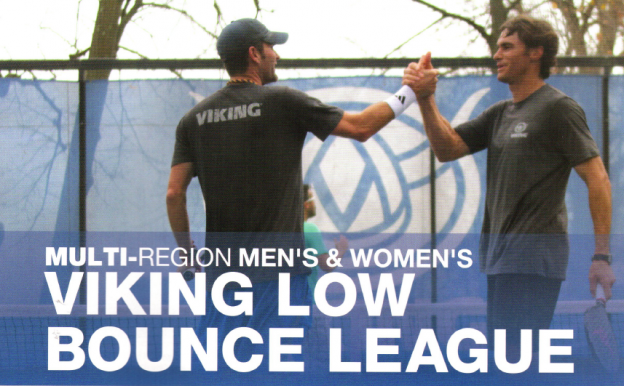
Inauguration of Viking Low Bounce League

It’s mid-March and the last platform ball has hit the aluminum. The platform leagues across the country are crowning their league champions. But for many of us, we experience a sense of withdrawal that kicks in right after the season is done. The desire to compete more and socialize with friends continues to fuel us. To add to that feeling is the plain fact that the weather in mid-April thru the beginning of June has not warmed up—it’s still platform weather. Along with the want for more platform, there is also a sense of wondering among the league champions. A wondering if my teammates and I are the best team in the country at our level….[read more – click on image]

Source: Platform Tennis Magazine, Vol. 15, Issue 4 Feb/March 2014

APTA Board Member Profile – David Lee

David Lee
Residence: Darien, Connecticut
Occupation: Investment Management
Years of Service on the APTA Board: 1
Family: Wife, Jenny; Daughters, Isabel, 18, and Julianna, 16
Years Playing: 10

How did you get started playing platform tennis? The first time I played platform tennis was in 1994 at the invite of a friend. I had played competitive junior tennis and thought it would be a breeze. However, many service faults, missed drives, and screen embarrassments later, I thought the game was silly and I didn’t play again for almost 10 years. In 2003, I joined the Milbrook Club in Greenwich, CT, which had three courts and a solid core of players. My tennis friends encouraged me to give it another go, and this time I also took some lessons. From there, my playing took off. The camaraderie, sportsmanship, and mental aspects of the game made it addicting. I also realized that while my best tennis days were behind me, my best platform tennis days were ahead of me. Soon, I was playing two to three times a week and competing on Milbrook’s interclub teams, one of which I eventually captained. I later was introduced to Mike Gillespie, who was teaching my daughter, and he was kind enough to introduce me to others in the platform tennis community, which really kicked up my involvement.

Contribution to the APTA Board/Contribution to the
platform tennis community:
I’ve just joined the APTA Board so hopefully I will have a lot to contribute going forward. One project I am trying to lead is a capital/endowment campaign that would provide the APTA with a permanent base of capital to help support and grow the game through grants and special projects. I am also part of the 2014 APTA Mixed Nationals Tournament Committee, headed by Patricio Misitrano.

Favorite on-court moments: I have so many good platform tennis memories that it is hard to pick just one. My two favorite on-court moments would be: 1) The clinching point with Hardy Manges for the Greenburgh team against New York Athletic Club in the finals of the highly competitive Westchester League. Greenburgh is stacked with ranked players like Sebastian Bredberg, George Wilkinson, Anton Mavrin, Max LePivert, and Mike Gillespie. I was fortunate to be asked to join the team and I quickly became “first sub,” i.e., after the weekly line-up would go out, the captain would say, “If anyone can’t play last minute, David’s available to sub.” In the playoffs, I somehow snuck into the lineup and won a three-setter at the 5th line to clinch the victory for the team. 2) In a Milbrook Pro-Am three years ago, I was across the court from Mark Parsons. We played a long point that included nicks, shots bouncing backwards and around the post. After the point was over, Parsons said, “That was the craziest, best point I’ve ever played!” Nice comment from the game’s top player.

Past/future endeavors not platform tennis-related: I have played in the World Series of Poker three times. I have won the New York Metropolitan Father-Daughter Golf Championship in 2011 and 2013 with Isabel, a former runner-up in the 14 & Under Junior Nationals.

Favorite quote regarding sports/life lesson: “I’ve missed more than 9,000 shots in my career. I’ve lost almost 300 games. Twenty-six times I’ve been trusted to take the game winning shot and missed. I’ve failed over and over and over again in my life. And that is why I succeed.” – Michael Jordan.

Source: Platform Tennis Magazine, Vol. 15, Issue 4 Feb/March 2014

Volunteer of the Month – Peter Dampf

Recruiter, Captain, Commander, Communicator

If you were at the Nationals last year at Indian Trail Club, there is a good chance you saw Peter Dampf in action. He seemed to have all the answers. He knew who was playing and where, how to update the Live Scoring, and where the balls were kept. He also knew about half of the players, having recruited many of them for his Division 1 team in the Westchester League (WPTL) in Greenburgh, New York.

Dampf plays platform tennis about three times a week, but has recently had to restrict night match play due to some vision issues. As a non-playing captain, he sets the line-ups and will put himself in for at least one match as long as it doesn’t hurt Greenburgh’s chances for a top-seeding in the yearend Division 1 tournament. His dedication to his team is note-worthy. And his post-match emails are legendary. With humor and wisdom, he discusses each pairs’ strengths and weaknesses. Russ Jellinek said, “Even though I am not a team member, Wednesday morning would not be complete without receiving Peter’s point by point, shot by shot, match recap via email each week. No one weaves a tale better than Peter!”

He’s been playing the game for about 40 years in the Scarsdale area, having learned the game from Jack Randall, who was responsible for starting the WPTL. Since Dampf s team plays at Rumbrook Park, a public facility located in the town of Greenburgh, Dampf, with co-captain Patricio Misitrano, is allowed to recruit from wherever he desires. By doing this, his coaching status has taken on new meaning around the town and the league. His number one recruit this year was Marco Grangeiro (currently ranked seventh nationally), who along with some young guns have propelled the team to the top of the league….[click the image to read more]

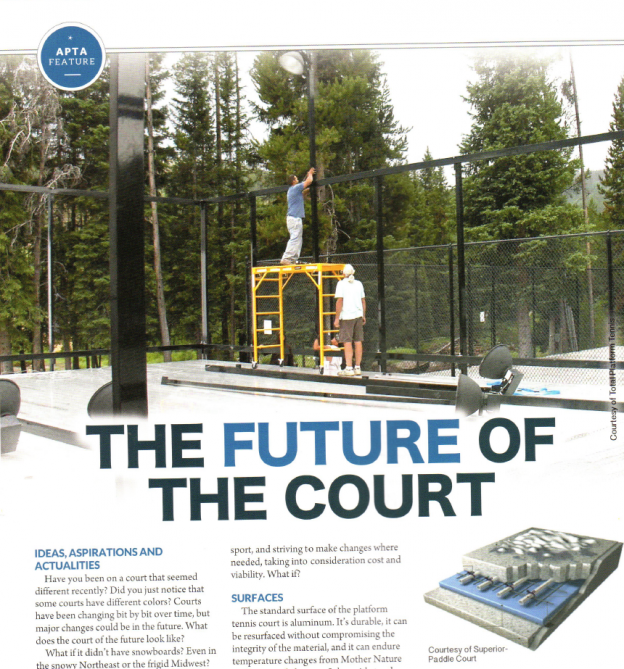
The future of the court – more innovation

Court construction has come along way from that first deck built in 1928. New technology is being put to work to make them better all the time. PTM had the update.

Ideas, Aspirations and Actualities

Have you been on a court that seemed different recently? Did you just notice that some courts have different colors? Courts have been changing bit by bit over time, but major changes could be in the future. What does the court of the future look like?

What if it didn’t have snowboards? Even in the snowy Northeast or the frigid Midwest? What if the courts weren’t aluminum? What if the surface didn’t have grit since it never got slippery from the snow? Can’t you hear the knees and backs out there applauding? All the other elements of the court—lights, door locks, wires, net posts—could be or have been reconceived as well.

There are innovators out there thinking aboUt the court materials for our growing sport, and striving to make changes where needed, taking into consideration cost and viability. What if?

Surfaces

The standard surface of the platform tennis court is aluminum. It’s durable, it can be resurfaced without compromising the integrity of the material, and it can endure temperature changes from Mother Nature and man-made heaters. It has withstood the test of time. Many of the first aluminum courts, built in the 1980s, show little sign of wear. So does it need to be changed?

When platform tennis migrated south, heaters were not a necessity and the courts didn’t have to be raised. Concrete was the first accepted alternative surface. As Bob Stratton, a player living in Atlanta, put it, “While I appreciate the ‘legacy of the game,’ we were able to move from wooden to aluminum courts. Why not other surfaces?”

Stratton, who is not a court builder, but a materials engineer and business owner, is interested in progress. When he travels to trade shows, he investigates different courtsurfaces and talks about them with different vendors. “There is an international sport out there that has championships played on four different surfaces. Why not ours?”

He has explored materials used on oil rigs, which has built-in grit and is non-conductive, important for outside work and play. The pultruded composite fiberglass decking is half the cost of similar aluminum. “You can customize the design to make it as flexible or stiff as you want. The grit level can also be customized,” Stratton explained. He also looked at the aircraft carrier surface. Sized in 2×2 tiles, it is made of a vacuum-formed plastic. Aircraft carriers use deicer when they need to get rid of snow and ice, and in Atlanta, bar the recent unusual spate of winter storms, they don’t need to de-ice too often. It is a surface that would work with radiant heat, another innovation being looked into for platform tennis courts.

Stratton’s contribution to the research and intelligence gathering extends to all facets of the court, but he’s just experimenting. He sees the possibilities outside of the standards. “Even the screen posts could be made of a different material. I think there is a whole lot that could be done on materials to lower costs. We need resources, grants, and to realize the possibilities,” Stratton opined. “If someone could purchase large volumes of the materials to get the cost down, and have the builders buy from that source, the courts would be standarized and the cost could be lower. Court cost, I believe, is an impediment to the growth of this sport.”

Jean Kempner, a teaching pro and player for over 30 years, who now lives in Las Vegas, has ideas about courts for the North. He, too, isn’t convinced that courts need to be raised anymore. “We don’t need heat on the courts– at least players don’t in order to stay warm; we need snow and ice melting capability. The propane heaters in place these days always have hot spots and cold spots and don’t offer thorough drying.”

Kempner is trying to convince people that building platform tennis courts with a cushioned tennis court surface, such as the US Open and Australian Open’s Plexicushion, is a good solution. “This helps reduce the hurt backs and bad knees that result from playing lots of paddle on unforgiving grit-coated courts,” Kempner stated, one of the main reasons he thinks new surfaces need to be explored. There would be no need for grit, which some believe causes injury. Kempner has created a whole concept court, which is patent pending, complete with removable net posts, so that the court can be used for other sports during downtime. [Look for Kempner’s Superior Court° system online.]

All of the “surfaces of the future” need about the same maintenance as today’s aluminum courts—resurfacing every three to five years—and cost about the same or less. Aluminum courts are tried and true because they last in the harsh elements of the North and Midwest for decades before they need replacing. “The aluminum courts we built in the early 1980s still look and play great,” said David Dodge of Total Platform Tennis.

Radiant Heat

The new surfaces described above would only work with a radiant heating system. There may be a radiant heat system that works on raised courts, also. While the expense of putting them in is high, they are more cost efficient over time.

Court builder Chris Casiraghi, of Reilly Green Mountain, talked about some heating systems they’ve tried. “Electric is the easiest to install for most clubs, but it is cost prohibitive to operate because of the high cost of electricity. It costs about $40,000 to install, but it keeps up with one inch of snow per hour. The other we’ve experimented with is a radiant heat using liquid glycol. This doesn’t freeze, but costs a lot to install on raised courts, since you have to have fittings for the tubes. It’s so close to the aluminum deck, [a downside is that] it sometimes flexes with the fittings, but once installed its really inexpensive to run.” Reilly Green Mountain has a testing plant in Orange, Connecticut, where they have set up a section of a court and leave it out all winter.

Speaking of inexpensive, installing propane heaters cost only $700 each, with an average of two heaters per court. However, the total bill for gas for the average four-court club reaches upward of $6,000 to $10,000.

Kempner is a proponent of hydronic radiant heat, which works well on helipads and hospital ramps. It would be embedded just below the court surface and would melt snow and ice, leaving a uniformly dry surface. He said, “The new technology in snow-melt solutions is revolutionary. It would also make
the courts more affordable. While it may cost the same to build, it would lessen the operating, in particular fuel, costs by half.”

Lighting

The technology is moving quickly, with tennis to thank for making big inroads in LED lights. Casiraghi stated, “Huts built in 2012 didn’t have LED; huts built in 2013 all have LED lights.” LED lights last much longer, about ten years, whereas metal halide, the previous standard, have to be changed every three to four years. Also, the LED uses less electricity, which cuts cost for users. As for the court lighting, array lighting may have its
use on our smaller courts, with directional lighting helping with those lost balls in the night sky.

Casigraghi said, “Right now, we have two clubs where we are testing two types of different wattage. Some of the questions are how bright the spot is and if you look at it, is it blinding? To test, we use computer analysis to see what should happen and compare that to what does happen on the court.”

Dodge has been working with stadium lighting for a few years, which offers much brighter night games. He said, “Although the stadium style fixtures have become the industry standard, we have been looking into and experimenting with LED for some time now. LED fixtures will offer greater energy savings and be maintenance free.”

Huts

Dodge stated, “Since the economy has loosened up, most projects are now two courts and a hut. There is a raised awareness, where clubs realize how the success of the sport benefits them.” Adding a well-outfitted but with new courts creates an instant mini club, which creates revenue. New huts have become multi-use facilities for clubs, who are willing to pay a premium for a well-designed building.

Wires

One of the industry frustrations is that the screen wire—with its particular gauge and tensile strength—is only available from Belgium. It used to be manufactured in Bridgeport, Connecticut, for prison camps, mostly. But after WWII, there wasn’t as much call for it. Dodge commented, “We are
begging someone to make our wire here.”

A player frustration is that there isn’t any uniformity regarding wire tension. David Meharg, of Putnam Tennis (newly partnered with Total Platform Tennis), is currently testing a tool that measures the consistency of wire tension. “Do you know how the builders test the screens? One of the crew members basically falls into the screens, putting all their weight into it and bounces off. One big sandwich at lunch might change how the wires are tightened! It’s not very scientific,” Meharg somewhat joked. “The screens have such a huge effect on the game. Some places the wires are dead, others loose, others just are right for you.”

Meharg invented a wire tension measuring device that reads the tension of the panels. When attached to the court, it gives a value to the tension of each screen panel. It quantifies a known amount, based on a scale of two criteria: deflection and balance. “The problem right now is, we don’t know what the best value should be,” Meharg explained. This will take player input and Meharg plans to arrange player testing after the winter season is over.

The extras you don’t really think about

Court Colors The surfaces are slightly more dynamic now, following in the footsteps of tennis courts. Gone are the brown and green that blended in to the natural surroundings. Courts are now blue and green or purple and green, with other options available. This has helped create contrast, particularly at night.

Door Closures Total Platform Tennis is a proponent of hydraulic closers. Dodge explained, “The old magnet ones stopped working well. We needed a magnet that worked well outside and couldn’t find one. The heat and cold doesn’t affect the new closers.”

What the game still needs

Meharg feels that the industry as a whole has to be more responsive with the delivery and installation of new courts. ‘We need to strike while the iron is hot. The faster we can build the courts, the faster people can get on them … there is a groundswell now and we need to take advantage! !” A collaboration between Putnam Tennis and Total Platform Tennis will hopefully increase their ability to manufacturer and deliver court systems and reduce the turn-around time on installations.

While new courts are being delivered in areas previously untouched, like New Mexico and Oregon, the mouse trap hasn’t changed since the 1970s.

Meharg, who has a technical background in the tennis industry, noted, “Most sports have constant improvement. The current court technology needs to be looked at and players have to be involved in the process. Surface technology has come a long way and the industry needs to comprehensively look at what the possibilities are and what is best for the players and the game.”

Dodge stated, “The growth of the sport is awesome – coast to coast, border to border.” Does innovation follow growth? If the builders and the innovators continue to invest in the game, there can only be a great future for the sport.

Source: Platform Tennis Magazine, Vol. 15, Issue 4 Feb/March 2014

APTA Volunteer Of The Month – Steve Webster

A Strong Proponent of the Game in the Midwest

A transplant from the East Coast, Steve Webster has now spent more time in the Midwest than where he grew up, in Glen Ridge, New Jersey. He has embraced the Midwest and embodies the spirit of it. He’s not just a really nice guy. He is an important part of the Indianapolis platform tennis scene.

Webster started playing platform tennis for fun at the Glen Ridge Country Club in New Jersey at about age ten. It wasn’t until he went to college at Lake Forest College, in Illinois, that he really started playing more. He joined the Chicago scene in its infancy, playing at the Onwentsia Club and was one of the masterminds with Rod Workman behind the growth of the game. In the 1980s, there was a “rule” that pros weren’t allowed to play in the league. Webster and Workman started the movement to change that rule. The pros then started investing their time in the game, building relationships with players, and widening their influence.

At the time Webster played in Chicago, there were only four levels in the league. (Currently, there are over 7,000 players in the Chicago league.) Webster left Chicago for Indiana in the early 1990s for work—he now holds the title of First Vice President at UBS Wealth Management—just as the sport was really taking off. John Hough said, “Webo was a huge loss to Chicago paddle when he moved to Indy. However, he took his passion there and has made the Indy tournament a favorite venue.”

Webster is happy he made the move to the Indianapolis area. He appreciates the lower cost of living and the natural friendliness of the people he surrounds himself with. While the platform tennis scene remains small, it is vibrant. Webster himself seems to have energy to burn, and luckily for the area, he has put that energy to good use……[click on the image to read more]

Source: Platform Tennis Magazine, Vol. 15, Issue 5 April/May, 2014

APTA Board Member Profile – Nathan LeFevre

Residence: Petaluma, CA; born in Tasmania, Australia
Occupation:
Head of Racquets at Lagunitas Country Club, Ross, CA
Years of Service on the APTA Board: One
Family: Engaged
Years Playing: 7-8

How did you get started playing platform tennis? When I was teaching tennis in Greenwich, Connecticut. I was originally taught the game by Jim Kaufman and Bob Kleinart.

Contribution to the APTA Board:
I am the Clinics and Exhibitions Chair and PPTA liaison. We held nine clinics this season, from New Jersey to Ohio to North Carolina.

Favorite tournament win: Lehigh PCQ/NRT with current partner Anthony Cosimano and winning the use of a private villa (thanks to tournament host Chip Morrow) in the Dominican Republic, which was an amazing trip.

Past/Future endeavors: I played juniors in Australia, making it to a top ten ranking in the 18 & Under division. After juniors, I started coaching tennis while at the University of Tasmania, where I graduated with a Bachelor of Commerce. In 2002, I moved to the United States to play Division I college tennis at Elon University in North Carolina for two years, and graduated with a Bachelor of Science in Business Administration. I played Futures events in Australia before working as a tennis and platform tennis pro at a few clubs, including Navesink Country Club, in Connecticut. I’m looking forward to playing more tennis and platform tennis events in the future.

Favorite quote regarding sports/life lesson:
“I play each point like my life depends on it by Rafa Nadal, one of my favorite tennis players. I really think it means enjoy every point and it can be related to life in general—you need to put everything you have into it.

Source: Platform Tennis Magazine, Vol. 15, Issue 5 April/May, 2014