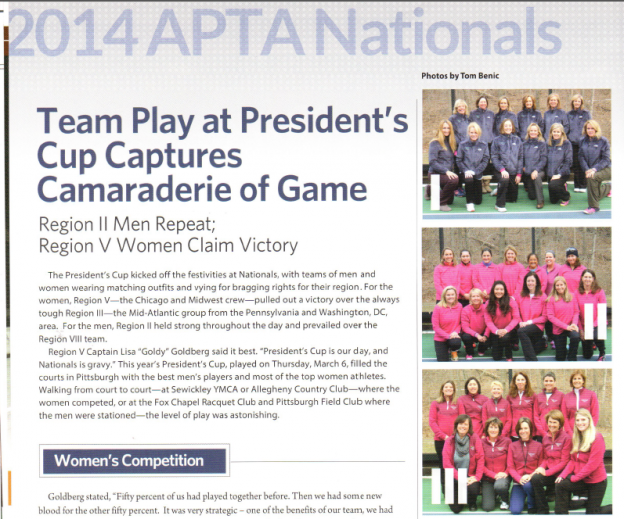
President’s Cup Recap – Region II Men Repeat and Region V Women Claim Victory

PTM Covered this popular event.

The President’s Cup kicked off the festivities at Nationals, with teams of men and women wearing matching outfits and vying for bragging rights for their region. For the women, Region V—the Chicago and Midwest crew—pulled out a victory over the always tough Region III—the Mid-Atlantic group from the Pennsylvania and Washington, DC, area. For the men, Region II held strong throughout the day and prevailed over the Region VIII team.

Region V Captain Lisa “Goldy” Goldberg said it best. “President’s Cup is our day, and Nationals is gravy.” This year’s President’s Cup, played on Thursday, March 6, filled the courts in Pittsburgh with the best men’s players and most of the top women athletes. Walking from court to court—at Sewickley YMCA or Allegheny Country Club—where the women competed, or at the Fox Chapel Racquet Club and Pittsburgh Field Club where the men were stationed—the level of play was astonishing.

Women’s Competition

Goldberg stated, “Fifty percent of us had played together before. Then we had some new blood for the other fifty percent. It was very strategic – one of the benefits of our team, we had Mary Doten and Chelsea Nusslock at the top. They were ranked ninth going in, so that was great. [Editor’s note: The top eight nationally ranked teams were not allowed to compete in the women’s PC.] We had a lot of depth. We had the capability to mix it around, and we did that a lot. Everyone knew going in that we wanted to win but I was going to make it fair. Region I and II are typically strong year after year. We did not think for sure that we were a shoe-in.”

Christi Hays, the 2014 Women’s President’s Cup Director, concurred, “The level of play across the board is just stronger. The group from California is getting better, the group from down South is becoming more competitive. There aren’t any weak links anymore.”

Regarding the team wear, Region V were easy to find in their red vests. Region III, led by Karin Kochis, rocked their dark pink fleece jackets. Region I won for being the fuzziest.

The competition was both fierce and fun. Teams had from 10-13 players and they rallied around each other. While many Nationals partners played on the same team, they weren’t always paired up for the President’s Cup matches. Combinations were often strategic and sometimes just plain neat—Laurie Hissey and Ali Tross (Region III) were a future mother-in-law and future daughter-in-law combo.

The women’s final was played under the lights, well after the men’s final had wrapped up. It was a long day of play but completely worth all the time, effort, and teamwork. “I’ve played in it before and I know what an important part of Nationals it is,” Hays concluded.

Men’s Competition

On the men’s side, Region II—New England—was rather dominant, losing only two matches the entire day. Captain Mark Parsons explained the President’s Cup system. “Our top eight players are placed on their regional team, and the rest are captains’ picks. For us, David Lee was a surprise – Guga Concalves went to Region VII to play with his partner Graham McInerney.”

The captains had to do some strategizing, choosing their pairs and matching teams at the right level. The final rounds started getting interesting; Region IV, a wandering region from Canada through Pittsburgh on to Kentucky, and Region II played off in a semi-final. The Midwest men, Region V, had to take on the rather strong Region VIII, a “region” put together to even out the number of teams. It was a close battle, but the VIIIs won the last match and were on to the finals. Region II, who had only lost one match in all of the rounds, coasted easily into the final.

When asked about his team’s experience, Scott Falatek, captain of Region III, said, “Our first match was key. We played Region W and we lost two of three tie-breakers. And we just couldn’t come back from that. We came in second last year, but … Juan Jaysingh was a key MVP for us this year. He brings a great energy and excitement for paddle to the team.” The sweatshirts Region III wore may have had a little magic woven into them; they were purchased from Hall-of-Famer Cindy Prendergast’s company.

Ben McKnight, caught just after his Region V team was eliminated by Region VIII, was able to find the good in the day. “I think the facility is top-notch. The organizers did a great job. We are all Chicago, except for Baxter/Heath from Indiana, and they went undefeated. The best part was the camaraderie. And there was not one disputed line call. It’s just a fun day.”

Mark Fischl, from Region I, who captained the Region VIII team, said, “We had some strategy. In the finals, we played Devin Wakefield and Brian O’Connor against Mike Cochrane and Juan Arraya.” Some people were questioning that matchup, but Fischl responded, “Wakefield and O’Connor know how to play fast, so I bumped them up in position.” In the end, Region VIII gave Region II their most competition, but it wasn’t quite enough. Region II won four of the five match-ups. In order to understand how strong Region II was this year, 10 of its 13 members made it to the Round of 16 at Nationals, and 7 players made it into the quarterfinals.

The President’s Cup, overall, was about groups of players who laugh, eat, and compete together and enjoy “twinning” for the day in their team outerwear.

“The APTA did a wonderful job. I love our guys and we had a great day,” Fischl said. “And we had the best outfits.”

Source: Platform Tennis Magazine, Vol. 15, Issue 5 April/May, 2014

The Juniors “Spirit of the Game” Award Is Presented to Mary Emma Guldi

One of Radley Run’s future stars shone brightly at the 2014 Junior Nationals

While demonstrating the good sportsmanship, integrity and respect that goes with the “Spirit of the Game” honor, this award is so special because paddle is a game where good sportsmanship is so keenly recognized. Independent but commanders were on the lookout for exemplary behavior during the tournament and, at the end of the day, the tournament committee made their decision.

The winner of this year’s “Spirit of the Game” Award is ten-year-old Mary Emma Guldi. A fifth grader at St. Agnes in West Chester, Mary Emma has played platform tennis at Radley Run for about three years.

Mary Emma lost her partner when the tournament date was changed, due to an ice storm, but still wanted to be part of the event. She created her own rainbow after the storm by signing on as a junior reporter for the APTA. She thought that being a tournament reporter would be fun, so she and her mother traveled from venue to venue, interviewing players and adults alike.

Mary Emma was lucky enough to interview the President of the APTA, Rob Coster, who drove down from Boston; the APTA Junior Tour Chairman, Steve Caccam from Connecticut; Ann Sheedy, the APTA Executive Director from Pittsburgh; and many of the players throughout the day.

She was a true professional, recording conversations, photographing key moments, and getting consent forms signed. Mary Emma then went home, compiled her notes, and sent in her article long before her deadline. She also took great photos, on and off the court. Her professionalism was impressive. “I thought it would be really fun to go and take pictures and interview people,” she explained. “I don’t think it will be my career. But I may do it a few more times.” Her article and photos can be seen on the APTA website.

Mary Emma was chosen from five nominees, each of who showed great integrity. But her unswerving energy toward her job was above and beyond, and she was very good natured about not playing.

“I was very surprised to get the award. Mrs. Hissey came to our house and presented me with it. I didn’t know about the award until this happened,” Mary Emma explained. “I want to thank them for choosing me, even though I wasn’t playing.”

We want to thank Mary Emma for her dedication to the game, for a superb show of sportsmanship, and for preserving the history of the 2014 Junior Nationals.

Congratulations to Mary Emma Guldi.

Source: Platform Tennis Magazine, Vol. 15, Issue 5 April/May, 2014

Junior Nationals

Screen Shot 2014-08-05 at 10.24.11 AM

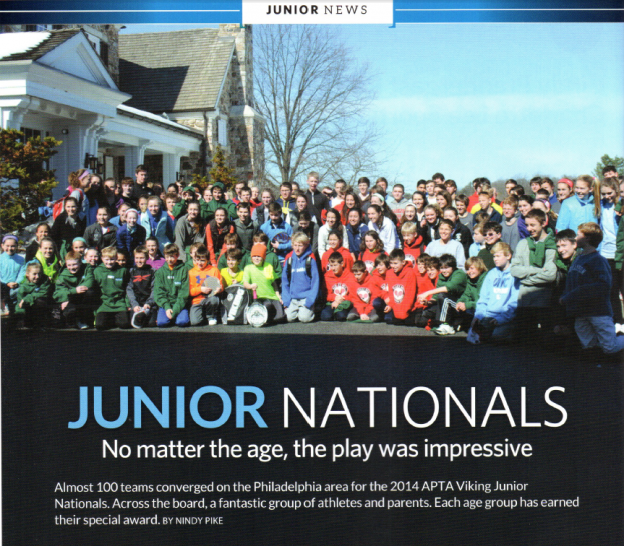
Despite the postponement almost 100 teams converged on the Philadelphia area for the 2014 APTA Viking Junior Nationals. Across the board, a fantastic group of athletes and parents. Each age group has earned their special award. Nindy Pike covered the event for PTM.
Screen Shot 2014-08-04 at 2.59.26 PM
Boys 10 & Under: Where The Wild Things Are

What you might see on the court when young boys are on the court: sunglasses, puffy coats, loud high-fives, hunter-safety hats, dance moves. What you will definitely see: topspin drives, low screens, and some fist pumps. The champions, Charles Brossy and Griffin Cramer, have won four junior tournaments this season. The finalists, James Lorenzetti and Trevor Ramirez, have won one gold together, and one gold each with partner Charlie Stuhr. A small but mighty foursome. (Heard in the hut: “They are so cute, I could eat them up!”)

Girls 12 & Under: Your Smile’s So Wide

Ten teams, including some 10 & Under pairings, played at the St. David’s Golf Club for the preliminary rounds. The upper deck offered great viewing of Court 1. Players waiting for their next match played net less rallies in the parking lot. One team’s ball flew deep into the snow field, and both girls were searching for it when their next match got called. They laughed coming out of the thigh-high pile, and headed for the court with snow in their shoes. One match ended in cries of joy from one 10s player’s mother, as the youngsters were able to win one game off their older and taller opponents. The final match, with Taylor Dean and Ava Ignatowich winning over Phoebe Brinker and Leah Walter, 6-4, 6-3, included ripper drives down the middle and high lobs, with both teams smiling and smiling.

Boys 12 & Under: Strategy-Fest

With 16 teams in the draw, the boys took over Overbrook Country Club and Aronomink Country Club for the early rounds. The final match was a strategy fest and a slug-fest. Aidan Donoho and Ty Brinker had only played a few times together this year on the paddle court, but many times on the tennis court. They took on perennial opponents, Marty Alexander and Harrison Kulick. Donoho and Brinker looked like the Bryan brothers, finishing points solidly, always communicating and low-fiving after every point. The first set went well for them, after the very first serve hit the nick. But Alexander, who gets high marks for his deep knee-bends, and Kulick, with some of the softest hands in the bracket, were both quick and steady, and rallied back in the second set, during a tense tie-breaker. Two back, offensive blitzes, 30-hit rallies, these kids did it all. Final score Donoho/Brinker, 6-1, 6-7, 6-3.

Girls 15 & Under: Twin Power Activated!

The Burkhart sisters had a large home crowd behind them, and that may have tipped the scales. Twelve teams faced off in the early rounds, with the final turning into a repeat of last year’s 14s, with a three-set, high-intensity match. Callie and Catie Burkhart eked out a win over Emily Dardis and Alexandra Shay, who didn’t give an inch for one minute. Shay’s off-pace dipping return was tough to return. The sisters both had huge drive returns and soft drops in the middle. It was their third age group title in three years, having won the 14s and the 12s. “Catie is more aggressive,” Callie said. “Callie has great lobs. We balance each other out,” Catie said. “We communicate well, and it’s easy to play together, since we are sisters. We stay positive, even when we are losing.” For their part, Dardis and Shay may as well be twins, having played together in many Junior Nationals, winning the 12s in 2011, and being the daughters of long-time partners, Cynthia Dardis and Amy Shay. (The mom’s won the APTA Women’s 45+ Nationals that same weekend.)

Boys 15 & Under: Putting The Mental In Fundamentals

In a repeat of last year’s 14s final, Will Cannon and Henry Fishman defeated Will Graham and Henry DeCoster in a very close two-setter, 6-4, 7-5. The champions have been playing together for five years now, coached by Guga Goncalves, who traveled from Connecticut to watch his menthes. Fishman commented, “We stayed patient. One thing that really worked was my partner hit his drives well.” Cannon said, “We got a little aggressive in the beginning, but started lobbing and stayed patient.” Obviously, they were on message; everyone watching in the but made the same comment. They threw up high lobs and put down soft middle balls, and had solid hands at net to defend against drives. It was the most patient foursome of all the courts.

Girls 18 & Under: Standing Room Only

Meghan Foster and Hannah Kratky have won Junior Nationals three times now, and there is good reason for that. They handled their opponents’ huge drives well, and created a calm atmosphere on the court. Finalists Bella Echevarria and Meredith Hughes threw all the groceries at the girl, but couldn’t break down Foster and Kratky. The final score was 6-2, 7-5. The last match of the day, the girls had a great fanbase in the Strathhaven High School Paddle Club. Ten players from the high school team, newly formed and working without an adult mentor, played at Junior Nationals this year, and were taking in all they could from the high-level play on the court.

Boys 18 & Under: Boyz To Men

Gardner Tregellas and Will Burger have been on the junior circuit for years. They dialed in all of their experience in a lopsided final against Austin Holmes and Reed Schultz at 6-1, 6-1. The power was impressive; the points at most times were very short, but on occasion were classic and long. Tregellas and Burger have taken home two gold and two silvers from Junior Nationals over the last six years. Holmes and Schultz won a silver in the 14s in 2011. The boys have learned a great deal playing in area men’s leagues and it showed on the court.

Congratulations to the winners, the finalists, and all of the players for continuing the great tradition of sportsmanship at the 2014APTA Viking Junior Nationals. It was an award-winning day!

Source: Platform Tennis Magazine, Vol.15, Issue 5 April/May, 2014

Cindy Prendergast Receives the Charlotte Lee Sportsmanship Award

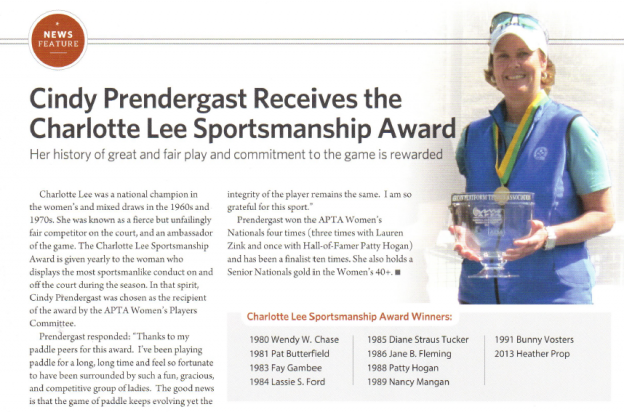
Charlotte Lee was a national champion in the women’s and mixed draws in the 1960s and 1970s. She was known as a fierce but unfailingly fair competitor on the court, and an ambassador of the game. The Charlotte Lee Sportsmanship Award is given yearly to the woman who displays the most sportsmanlike conduct on and off the court during the season. In that spirit, Cindy Prendergast was chosen as the recipient of the award by the APTA Women’s Players Committee.

Prendergast responded: “Thanks to my paddle peers for this award. I’ve been playing paddle for a long, long time and feel so fortunate to have been surrounded by such a fun, gracious, and competitive group of ladies. The good news is that the game of paddle keeps evolving yet the integrity of the player remains the same. I am so grateful for this sport.”

Prendergast won the APTA Women’s Nationals four times (three times with Lauren Zink and once with Hall-of-Famer Patty Hogan) and has been a finalist ten times. She also holds a Senior Nationals gold in the Women’s 40+.

Charlotte Lee Sportsmanship Award Winners:
1980 Wendy W. Chase
1981 Pat Butterfield
1983 Fay Gambee
1984 Lassie S. Ford
1985 Diane Straus Tucker
1986 Jane B. Fleming
1988 Patty Hogan
1989 Nancy Mangan
1991 Bunny Vosters
2013 Heather Prop

Source: Platform Tennis Magazine, Vol. 15, Issue 5 April/May, 2014

Museum and Hall of Fame Foundation Video – Platform Tennis: A celebration of the game, its camaraderie and those that made it happen

The video is a short history of the game from its start in 1928 through to 2014. It highlights the key events in the game’s development, the leading players, the role of the APTA and the Foundation’s efforts to document the story for the next generations of enthusiasts.

The video was produced by Camille Thoman who produced the indie documentary The Longest Game which was inspired by a group of octogenarians at Dorset Field Club, Dorset, NH who met regularly to play paddle and reminisce.
Screen Shot 2014-08-04 at 1.58.04 PM

Click link to play: Platform Tennis: A celebration of the game, its camaraderie and those that made it happen

Mary Doten and Susie Keane Inducted into the Platform Tennis Hall of Fame

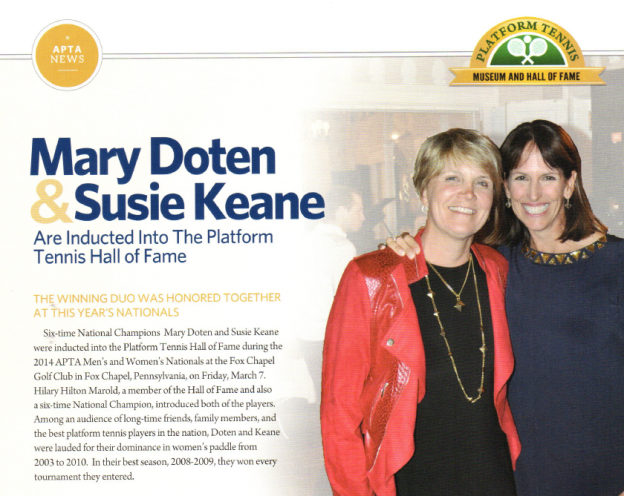
Six-time National Champions Mary Doten and Susie Keane were inducted into the Platform Tennis Hall of Fame during the 2014 APTA Men’s and Women’s Nationals at the Fox Chapel Golf Club in Fox Chapel, Pennsylvania, on Friday, March 7. Hilary Hilton Marold, a member of the Hall of Fame and also a six-time National Champion, introduced both of the players.

Among an audience of long-time friends, family members, and the best platform tennis players in the nation, Doten and Keane were lauded for their dominance in women’s paddle from 2003 to 2010. In their best season, 2008-2009, they won every tournament they entered.

Screen Shot 2014-08-04 at 11.36.20 AM

The following are excerpts from Marold’s introduction speeches and from the winners’ acceptance speeches.

Mary Doten Introduction

In 1993, some tennis friends of Mary’s convinced her to come out and try platform tennis and she became hooked on the sport. They had ulterior motives in that they were trying to get Mary to join the Hinsdale Women’s Platform Tennis League team, so Hinsdale had a chance to dethrone the paddle queens of Chicago’s North Shore League, the mecca of platform tennis play at the time. Mary joined the team and Hinsdale won the North Shore Women’s PT League for the first time ever. Platform tennis was growing well beyond the North Shore now.

Mary’s weapon of choice on the court from the beginning had been her two-handed backhand drive return of serve. Both her forehand and backhand drives came at her opponents with heaviness, speed, and accuracy. Her backhand was a bit more deceptively hit, slightly harder to read. Pair these shots with the intimidation of her following it to the net and in a quick blitz, Mary had turned defense into offense and now had control of the point.

With this new tactic of freely blitzing added to her already successful arsenal of drives, it was only a matter of getting paired with the right partner before a National APTA Championship would be hers. That all came together when Mary paired in 2003 with Susan Keane. They won the first of many APTA National Championships together as a team that year. They won the APTA Nationals six times together: 2003, 2004, 2006, 2007, 2009, and 2010.

When Susie Keane retired from platform tennis competition, Mary joined forces with Chelsea Nusslock from Lake Forest, Illinois. They were semi-finalists at Nationals in 2012 and finalists in the 2013 APTA Nationals. Besides the fact that Mary is still an active, competitive force to be reckoned with on a platform tennis court, she has a very busy teaching and coaching schedule. And now, she is the recipient of the APTA’s highest honor, the Platform Tennis
Hall Of Fame award to Mary Doten.

Mary Doten Acceptance Speech

I am deeply honored to be standing in front of all of you. I look around and see so many amazing people and talented players and am truly humbled. Luck has played a big part of my paddle career. I was first introduced to paddle by no less a player than six-time National Champion, Hilary Marold, who I knew through tennis.

Hilary pulled me out on the court, showed me the game, and nearly immediately had me driving an hour each way to the North Shore of Chicago for team competitions. My apprehension at not knowing a lick about paddle was met with Hilary’s assurances that I would do just fine. I guess she was right. What a joy to have her here with Susie and me tonight.

Luck would lead me to some great platform teachers in Hank Irvine and RayJ Murphy. They were instrumental in motivating me to work on my game while still playing to have fun. I was perhaps the first woman player to prefer her backhand. They supported my unusual choice to return with a backhand.

Perhaps it had something to do with them seeing my forehand! I was lucky enough to find a partner in Susie Keane just as she had moved to Chicago and got the paddle bug. She is one of the toughest competitors I have ever encountered and it was a great ride to partner with her for eight years. Once Susie moved her family down to Florida and found a new passion in golf, I was in search of a new partner. I was lucky to find an energetic and fierce young competitor in Chelsea Nusslock. Chelsea never hesitates when I say “Yours” on any and all drop shots.

These last three years with Chelsea have kept me in the game and enjoying it every step of the way. I have been lucky to be a part of a great program in Hinsdale paddle. Great paddle ambassadors like Bill O’Brien, Paul Wiggin, and Charlie Usher have spent countless volunteer hours promoting park district paddle and have taught me the importance of giving back to this great sport. Through the parks program we have been able to introduce paddle to several hundred new players in the Hinsdale area.

And through paddle I have made wonderful friendships, another stroke of luck. Backtrack over 30 years and the jackpot of good luck brought me Gary Doten. He was the first guy that I met at Freshman Initiation at Wake Forest; although it was over three
years until we started dating. Once married we had three great kids, Andrew, Scott and Anna, all here tonight. I can still remember the first time I sheepishly asked Gary what he though of the idea of me playing in Nationals while he stayed home with our then 4-year-old and twin 1-year-olds. He replied, “Yes, definitely, you should play! Can I do anything to help you get ready?” Nearly 20 years later, it is still his response. He has been my biggest supporter and I love him dearly.

Susie Keane Introduction

Susan started out very young trying to be the best she could be at whatever she was doing. To win her first professional singles title in tennis at only 14 years old was a good example of her love of competition, her maturity, perseverance, and solid work ethic. At 16 years of age she became the U.S. Open Girls’ Singles Champion and the ITF World Junior Champion, 1980.

At the end of 1988 Susie retired from professional tennis competition. Susie and Peter married and moved to Lake Forest, Illinois. This was where Susie Keane’s platform tennis roots took hold. She started playing platform tennis with lots of new found friends. She enjoyed the competition and began transferring the same mental fortitude and passion to succeed from her pro tennis days to her newfound sport of platform tennis. It didn’t take Susie long.

The 2003 APTA Nationals was approaching. Mary Doten was lined up to play with Julia Sierks, but at the last minute Julia had a family emergency arise. The rest is history. At least, APTA history. Mary convinced Susie to fill in for Julia. Mary told Susie, “Come on. Well just do it for the experience.”The first time pairing of Doten-Keane, unseeded in the tournament, swept through the draw, beating seed after seed until, indeed, the 2003 APTA National Women’s Championship trophy was theirs.

After Susie won her first nationals, there was no resting of her laurels. She worked even harder on her game, training, hitting repetition drills with other players and tennis pro, RayJ Murphy. All of her training in the off-season paid off as Doten-Keane successfully defended their national title with a win in 2004,

After her 2010 win, Susie retired from competitive platform tennis. She and her family now live in Orlando, Florida. She is surely the definition of a “champion.” Platform tennis is better off for having Susie Keane a part of its history. And now, she is the recipient of the APTA’s highest honor, the Platform Tennis Hall Of Fame award to Susan Mascarin Keane.

Susie Keane Acceptance Speech

Thank you Hilary for that introduction and thank you to my partner, Mary Doten, who I share this honor with … you were my first and my last paddle partner so you pretty much taught me everything I know. It was always a pleasure to play with you, win or lose!
I would also like to congratulate Bob Callaway who will be inducted next week in New York and I’d like to thank the Platform Tennis Hall of Fame Committee for all they do and for selecting us this year and to everyone for being here tonight — it’s really great to see so many of you again and also to see so many new (and young!) faces.

You never know what’s in store for you. Eleven years ago we moved from Detroit to Chicago and I went looking for a place to play tennis … but with RayJ Murphy’s influence, was soon playing way more paddle than tennis. And then, after being talked into going to play in my first Nationals (just for the experience), I was hooked for the next eight years and lucky to have Mary by my side — in the backhand court blitzing her way to net over and over again!

My paddle days seem a long time ago though it’s really only been just over three years that we picked up and moved (again! Part of my husband’s job description) to Orlando. (I wish I could say that the move helped my golf game but sadly the opposite seems true.)

But back to paddle, I miss the competition, the exercise, and the camaraderie. It truly is a wonderful sport! I hear there are paddle courts in the Villages about an hour away but I think I’m still a few years from exploring that option!

Thank you all again for allowing me to take this trip down memory lane and reminding me how fortunate I was to play this great game with so many of you.

Bob Callaway Inducted into The Platform Tennis Hall of Fame

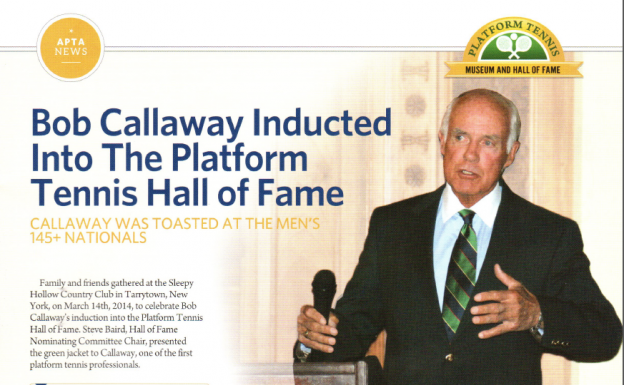
Family and friends gathered at the Sleepy Hollow Country Club in Tarrytown, New York, on March 14th, 2014, to celebrate Bob Callaway’s induction into the Platform Tennis Hall of Fame. Steve Baird, Hall of Fame Nominating Committee Chair, presented the green jacket to Callaway, one of the first platform tennis professionals.
Screen Shot 2014-08-04 at 11.21.12 AM

The following is excerpted from Steve Baird’s introduction speech.

We are here tonight to honor a very special person, a trail blazer who dedicated almost his entire career to platform tennis. No one has ever done as much, on such a full-time scale, with such longevity as Bob Callaway. At his core, first and foremost, Bob was a teacher. It was not about him, it was about his students. He cared deeply about them and their progress.

Bob was arguably “the first paddle pro.” He began in the late 1960s and retired in 2012 at age 78. Today, there are well over 200 paddle pros nationwide. He paved the way… these pros today are flourishing and providing vital leadership, energy, and growth.

He was a top 16 player on the 1970s tour and later became a National Senior Champion. He was known for his signature lefty kick-spin serve (a truly nasty shot). But tournament play was not where Bob was destined for greatness. It would be in a far broader realm. Bob was also an entrepreneur and risk taker who opened the first commercial Paddle Center in Norwalk, Connecticut, in 1972. For ten years, this was a gathering place for men, women and children from all over Fairfield and Westchester. Bob literally introduced the game to thousands of people at this first public paddle center.

As Bob’s career progressed in the 1980s, 1990s, and 2000s, he served with great distinction as the Head Paddle Pro at the New Canaan Field Club and Wee Burn Country Club, and taught a number of other local clubs including the Greenwich Field Club. He also began to consult in the executive presentation skills field and made regular trips to teach his corporate clients in New York City and Connecticut. This made for very long days… as in when he wrapped up a seminar with business executives, he then had to dash off to a 7:00 PM the car or the bathroom on the train.

Bob was also an author, writing a book titled Platform Tennis. It was an overview of the game, its history, with insights into each stroke. It served as a very sophisticated teaching guide and 225 pages no less. He was a founding member of the PPTA and an APTA Board member. He played a vital role in stewarding APTA Rules and recruiting and training umpires. He conducted certifications programs over many years. He was always generous with his time whether it be traveling to the R.J. Reilly Paddle camps at Jackson Hole or helping lead the Viking Junior Kick-Off Academy. Bob’s enthusiasm for the game was contagious and this positive attitude made learning fun. In many ways, he became an ambassador for the sport. He coached many National Champions at various stages of their careers (collectively these individuals won over 60 National Championships). Many of these players are in the audience tonight. They’re here to honor Bob, for all his support, his guidance, and his friendship.

As one of his protégé’s said, “Bob worked a lifetime to grow platform tennis – he did this by connecting and inspiring others. Bob’s legacy will always be about the people who he helped to get involved in the game.”

And now, he is the recipient of the APTA’s highest honor, the Platform Tennis Hall of Fame award to Bob Callaway.

Source: Platform Tennis Magazine, Vol. 15, Issue 5, April/May 2014