APTA studies the history and formats used in the Presidents Cup in order to provide guideline for future events – Gary Horvath chairs the committee

Purpose of the study:

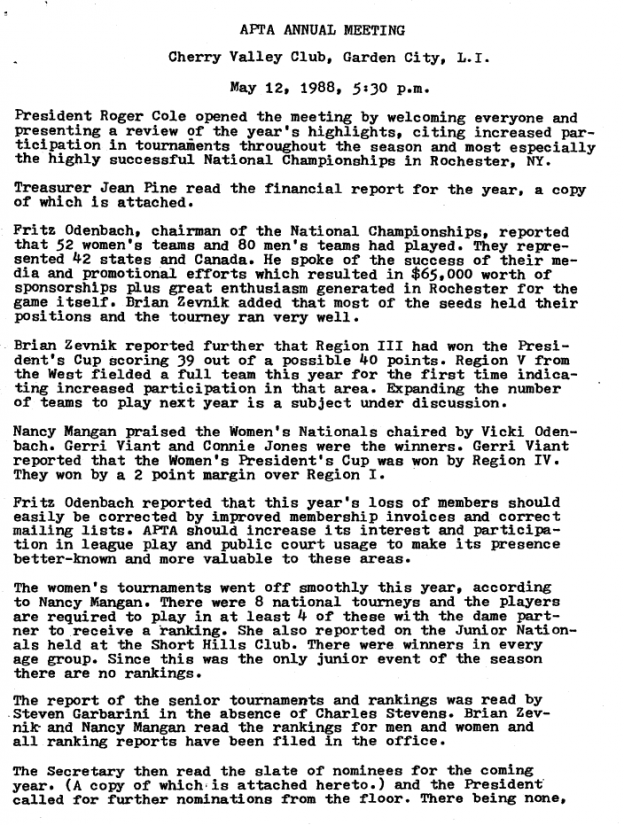
At the May 1988 meeting of the APTA Board of Directors Gary Horvath was asked to chair a committee to work with Fran Sennas to study the Presidents’ Cup. This study will be conducted in several phases.

Phase I is the compilation of the history of the APTA Men’s and Women’s President Cup. This event has developed a tradition as rich as that of the National Championships.

The event has had a number of formats, a wide variety of sponsors and at times its share of controversy – primarily in administrative matters. Throughout it all, the events have been characterized by an unparalleled amount of camaraderie, sportsmanship and fun.

Hopefully an accurate record of these happenings can be compiled while the individuals who made this event so great are still interested in the great sport of platform tennis.

The purpose of establishing an accurate record of the Presidents’ Cup is to make it easier to determine what direction the event should have in the future.

Phase II will be the compilation of a variety of viewpoints in hopes of placing as many ideas on the table as possible considerations for the direction of the event.

Phase III will be a set of recommendations and guidelines to the APTA Board of Directors as to the future of the Presidents’ Cup.

Read: Full Report

APTA Board seeks more “gray hairs”

The APTA Board, sensing that its composition was perhaps a little heavy on youth and losing institutional memory, re-elected Bob Brown, who had served as APTA President from 1973–1975, for a second term. Bob continued this new assignment until 1998, resulting in a total of 22 years of service on the APTA Board.

APTA develops a database of places where the game is played

In the Mid-Winter edition of Platform Tennis News, the APTA published a long list of the clubs, schools and municipal facilities that made up its membership. They believed the list contained only half the facilities in U.S. and Canada, and so they encouraged readers to see if their facility was listed and, if not, suggest that it join the APTA.

More on the ball

APTA President Chuck Vasoll reported on progress in the Mid-Winter edition of PTN.

We received several responses to our ad for a “Rubber Chemist” to aid us in our search for improvements to “The Ball.”

We will be following up on them with the hope that it will be fruitful in bringing us an improved product for our game. Speaking of the “ball,” I recently delivered a supply to the captain of one our women’s teams. As I was descending the steps at the rear of her house, I could not believe my eyes. There growing in the garden were “Platform Tennis Balls.” Closer inspection, however, showed them to be yellow gourds. Unfortunately, this picture in black and white is not as striking as the color original, but you can visualize it. When I mentioned this finding and put up the picture on our warm-up hut bulletin board, I was told that it was a great idea to grow the balls, except the cost of the seed was $6.50 for a sleeve of three.”

Source: Platform Tennis News, Mid-Winter 1988

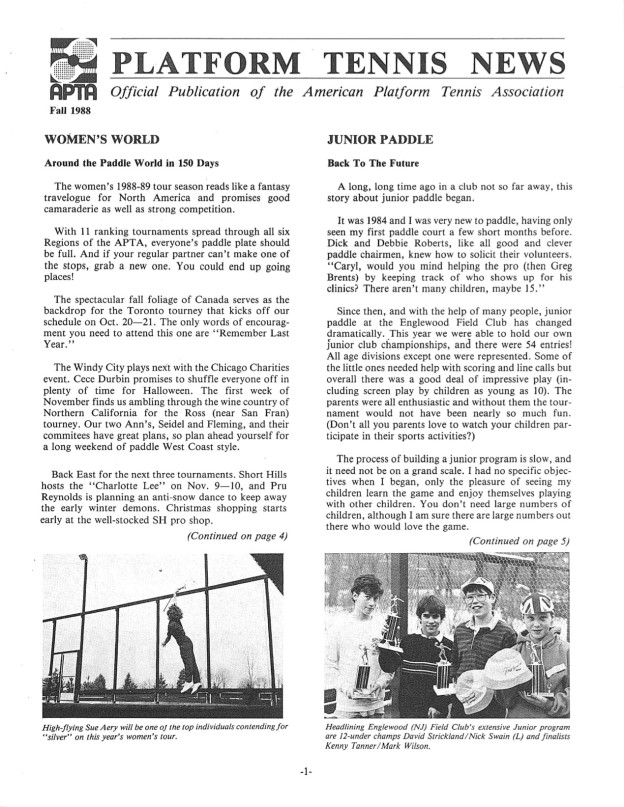
Fall 1988 edition of Platform Tennis News

APTA refocuses on Juniors

The APTA recognized that the development of the next generation of players had been overlooked in recent years and looked to rebuild interest with a National Clinic Days. The clinics would feature area pros and top players contributing time and expertise in conducting free clinics throughout the US and Canada.

APTA continues search for improvements to the ball

Walt Peckinpaugh, Region IV President and Board Member led an effort to address issues with the ball – how true it bounces, how long it lasts and how much it cost.

The following report was contained in the Fall edition of Platform Tennis News:

Late in May, Walt brought our concerns about the ball to our primary supplier, the Hedstrom Corporation, maker of Vittert platform tennis balls. In their conversation, several matters were discussed and plans to implement improvements were on the agenda of the June meeting of the APTA Board.

First and foremost, Hedstrom will continue to supply Vittert balls to the market at a competitive price. This is vital because we have no game without a proper ball. We are told, however, that there may be a substantial price increase because the costs of raw material used in the ball have more than doubled since last year. This is due to the demand for rubber for other products

Second, it is necessary to recognize that we are a very small market for a specialized product. Hedstrom does not see us as having “growth” potential. It cannot compensate for a small profit margin by large volume or an anticipated increase in future orders.

Finally, there is a need for research in the composition of the ball. Hedstrom has been providing Walt Peckinpaugh with samples for testing of different formulas of rubber and flocking. The company has indicated, however, that it does not have the funds or expertise to pursue this area any further. Management suggested that the APTA investigate the availability of a “rubber chemist” to assist in this research. Thus the “HELP WANTED” ad printed on this page. “

We are hoping our members can direct us to such a person or, better yet, have such specialized knowledge themselves. The goal of this research effort would be to find a rubber composition that will maintain or lower costs while standardizing the quality of the ball. Meanwhile, the APTA will continue to work with the Hedstrom Corporation to produce a product that will be priced so as not to be a deterrent to the further growth and enjoyment of the game and to maintain quality levels that are acceptable.

Source: Platform Tennis News, Fall 1988, and Mid-Winter 1988

Dick Reilly reflects on 29 years of court building

In the Summer 1988 issue of Platform Tennis News, the veteran court builder shared the following observations:

Head Hunters and Architects
In 29 years of building platform tennis courts, you could say we’ve seen it all—or at least most of it—from:

• Lifting a court to the top of a city building by helicopter, to

• Having a building crew told not to stray far from the building site in Indonesia, lest they loose their heads, literally, to

• Building a six-court complex at the top of NYU’s library only to move it several years later because the building’s world-renowned architect was insulted that he was not consulted before the courts were put on “his” building.

When I first played paddle 30 years ago, I was immediately enamored of the game, but horrified at the poor quality of the courts we all played on. Being familiar with construction, and believing the game would be around for a while, I felt I could construct a better quality court (despite the fact that it would take away my excuse that the bad bounces and poor screens were the reasons for my poor performance).

The King Kong Kiln
The first challenge in building a consistent platform tennis court was what to do with the joints where the boards met end to end. The only solution was to have no joints in the entire playing area. Since the only place on the court that isn’t really part of the playing area is at the net line, it meant either shortening the length of the court to have normal 20 or 22-foot boards meet at the net line, or somehow finding 30 foot boards. I was told by an architect that even if we were able to find such boards, they would warp, twists, and cup so badly that they would make the court surface far worse than the joints of shorter boards currently did. The only way to avoid that would be to have the boards kiln dried, and of course there was no way we could ever find a kiln that was 30 feet long. But we not only found a mill that would make 30 foot boards, but came up with a 30 foot long kiln as well.

Walnut Shells and Aircraft Carriers
The next challenge was the traction surface. Sand had been the norm as long as platform tennis courts were in existence. But I was never a big norm lover. I didn’t like the grainy, inconsistent surface and the way sand wore off, leaving a slippery, dangerous surface in the wet and snowy weather. I became interested in what was used on aircraft carriers where it was a matter of life and death (not to mention millions of dollars), if the traction surface in that wet environment wasn’t up to par. My search led to the shipping docks in New York City where I was surprised to find that ground-up walnut shells were used for their non-skid surface. After listening to people joking with me that the only way this idea would work for paddle courts would be to put my children to work grinding walnut shells all day long (I considered that!), we found a supplier willing to work with us to come up with the right size walnut shell to apply to wood court surfaces.

Paddle Meets the Metal Age
We still weren’t satisfied with the checking, twisting, warping, and decaying of wood courts and the large amount of maintenance work required on them from year to year. Knowing we were searching for an improved product, Phil Osborn (who introduced platform tennis to Pittsburgh and was an executive of Alcoa Aluminum) suggested we develop an aluminum court. This time it was my turn to laugh. I should have known better!

After a couple years of research, development, and working closely with several architects and aluminum manufacturers, we came up with an all-aluminum court–that no one wanted. The idea of almost no maintenance costs, a court that would outlive its owners, a consistent playing surface, and the ability to heat the deck to help remove ice and snow, thereby allowing play in virtually all winter conditions, was great in theory. Suggesting that people play on a metal platform court 18 years ago, however, was like suggesting Babe Ruth should hit with an aluminum bat. It just wasn’t done.

Happily, paddle players are not so stuck in their ways that they can’t weigh advantages against any perceived disadvantages of a “strange” new concept. Today, aluminum courts are virtually the only type purchased by clubs and players, and the game is enjoyed on trouble-free surfaces in all varieties of weather. The die-hard wood court lovers (myself included) are finding that the well-designed, well-built aluminum court feels and sounds very much like wood. It is almost to the point where a wood platform tennis court is now considered an endangered species.

The game of paddle has gone through about as many changes as the court itself has. It’s the important things, though, that never change. The game—and the court—are for people to enjoy.

Source: Platform Tennis News, Summer 1988

Ginna Ohlmuller becomes new Executive Director

The APTA named Ginna Ohlmuller as the new executive director. Ginna had a long history of platform tennis involvement that included several years as a nationally- ranked player on the women’s circuit, with partner Rita Goldberg; paddle chairmanship at the Montclair Golf Club for the previous three years, and a feared partnership with her son, David, in mixed doubles.