
Junior Nationals at Beacon Hill Club, NJ – Patty Hogan reported

Screen Shot 2013-05-22 at 9.22.21 AM

Patty Hogan reported on the event for PTM

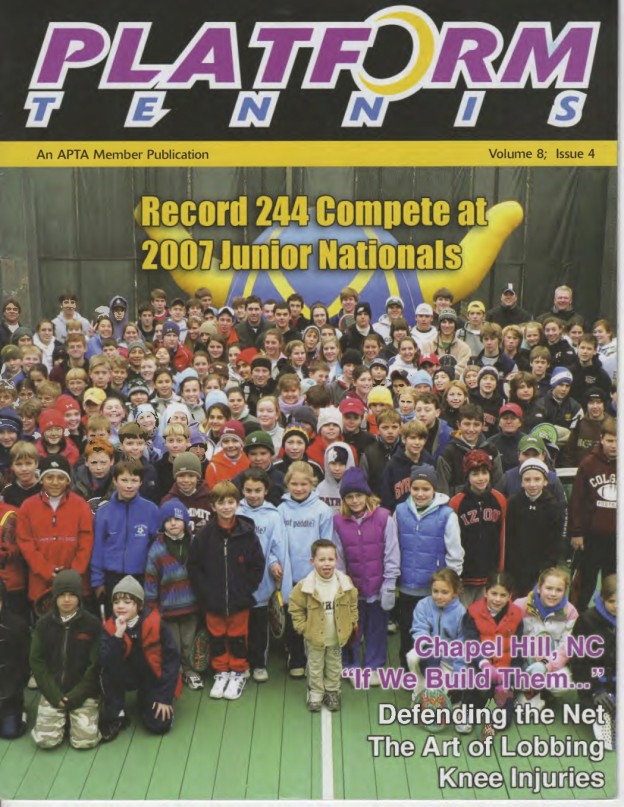
For the 10th year in a row, Patty Hogan and the Beacon Hill Club hosted the APTA Junior Nationals. The growth of junior programs throughout the country is evident with a record 244 junior participants this year! Although half of the players came from New Jersey, the total represented six states and four different APTA Regions.

The event was sponsorship by Marsh, Viking Athletics, the APTA Junior Development Fund, the New Jersey Men’s Platform Tennis Association, and the New Jersey Women’s Platform Tennis League. Bulletworks also sponsored the event by providing fun favors for all players.

It would be impossible to stage a tournament this size without a dedicated corps of volunteers. Thanks go out to: Patty Hogan, Marjorie Hodson, Sheryl Barcic, Bob Considine, Susan Penney, Terry Doran, Steve Bromley, Scott Slobin, Kent Chalmers, Drew Broderick, Clay Bibbee, Tim McAvoy, Jim Clark, Anthony Fleming, Kendall Osbourne, Chris Stagg, Sarah Krieger, Leila Safford, Laurie Hissey, Ron Cummins, Mark Bliss and all the Beacon Hill members who pitched in.

Thanks also to the New Jersey clubs and their members who loaned their courts for the afternoon: Beacon Hill Club and its helpful staff, Canoe Brook Country Club, Echo Lake Country Club, Essex Fells Country Club, Montclair Golf Club, Morris County Golf Club, Morristown Field Club, Noe Pond Club, Racquets Club of Short Hills, Short Hills Club, Spring Brook Country Club and Summit Tennis Club.

The expanded Girls 10 & Under division provided stiff competition, with the finals featuring a rematch of the New Jersey Junior Open champions and runners-up. Once again, Kendall Smith and Paige Moriarty topped Erin and Megan Hines in a match that featured great sportsmanship.

Phoebe Wilks and Ariana Ross took the Girls 12 & Under medals home, with a victory over Emily Schade and Hayley Snyder.

The 14 & Under Girls finals were a rematch of the New England Junior Open, with Margaret Souther and Rachel Whitney once again victorious over Lindsay Wheeler and Carly Fink. Lindsay and Carly won the Girls 14s at the Fox Meadow Junior Open to start the season. Margaret and Rachel were Girls 12 & Under champions two years ago.

The Girls 18 & Under title was a battle between the 14 & Under Champions from the last two years. Stephanie Brown and Christie Pollin, the 2005 champs, defeated last year’s 14s winners Hana Bowers and Karen Cash at the end of a long afternoon of play.

The Boys 10 & Under division showcased our youngest talent, with 25 teams entered, including the tournament’s youngest competitor, 6-year-old Mac Bredahl. With this group on the horizon, we know that junior paddle is on the rise! Jake Colville/Stephen Zabrowski defeated Bobby Clarke and Gerard Smith to earn the gold. Bobby and Gerard are Long Island Junior Open champions.

Tyler Kratky and CJ Purse followed their wins at the Fox Meadow Junior Open and the New England Junior Open and the New Jersey Junior Open Boys 14s with a win over NJ Junior Open champs Jameson Smith and Tim Mulrenan in the Boys 12 & Under division.

The Boys 14 & Under title was successfully defended by Nick Newhouse and Jason Ottomano, who defeated last year’s 12 & Under champs, Ryan Hissey and Scott Safford, in the medal round. In 2005, Nick Newhouse won the Boys 12 title and in 2004, Hissey/Safford took home the 10 & Under gold.

The 18 & Under Boys event was a battle between Hallet Nichol/Chris Kelley and Reid Coopersmith/Evan Zimmer. Nichol and Kelly were finalists at the Long Island Junior Open and Coopersmith/Zimmer were finalists at Fox Meadow and New Jersey. Hallet and Chris won an entertaining match to claim the top prize at Junior Nationals.

All champions received APTA gold medals, a new Viking paddle and a Viking director’s chair imprinted with the title “National Champion.” Runners-up received APTA silver medals and a new Viking paddle.

Source: Platform Tennis Magazine, Vol. 8, Issue 4, February, 2007

Concrete court decks? Why not says David Dodge of Premier Platform Tennis

A few years back, David Dodge of Premier Platform Tennis built two concrete grade-level courts at Ocean Pines, Maryland. The warmer climate sees little snow and therefore the necessity of a conventional deck was absent.

A few months ago, Dodge and Bullet Brown (Bulletworks Platform Tennis) completed two more courts at Ocean Pines.

The courts – not yet approved by the APTA – were not painted, except for the red lines. A broom finish was applied to the court for better footing. So what is the post installation verdict?

Resident players claim:

• The broom-finish provides very good footing and is considerably easier on the knees and ankles.

• The non-painted court is much brighter under the lights.

• The non-painted surface initially saves $3,000 per court and $2,500 every few years thereafter.

• Pitching the courts just two inches from the net to either end works well to drain rainfall by gravity compared to a level deck.

Source: Platform Tennis Magazine, Vol. 8, Issue 3, January, 2007

Player Profiles: Brad Kelly and Brett Englesberg

Brad Kelly

Age: 38
Married: Jenny
Children: Lauren (11), Anna (9) and Ben (6)
Born: Charleston, WV
Resides: Pittsburgh, PA
Education: BA Business Marketing WVU (1991)
Occupation: Director of Brokerage Services ECHO Real Estate

Like many of the top platform tennis players, Brad Kelly was a full-scholarship, Division 1 college tennis player. At WVU (Top 20 national college tennis team), Brad captained his team to nine conference championships in singles and doubles. He was one of three Division 1 All-Americans in WVU tennis history and he also earned a USTA National Indoor Doubles Championship title.

Brad moved back to Pittsburgh in 1995. He recalled, “I knew a lot of guys that played platform tennis at The Pittsburgh Field Club and they got me out there to give platform a try.” He added, “At first, I relied on the similarities with tennis – really the basics such as strokes and footwork. Over time, I learned the mental aspects. In tennis you look to finish points and that is the exact opposite of what you need to do in platform tennis.”

For several years, Brad played league matches as a social outlet. He said, “I met Brett through paddle in our league play. One night after we played each other we decided that it might be fun to try a few tournaments together. That was four years ago.” He added, “I think that the biggest help for my game has been to travel and play tournaments. When you play the same people all of the time it can be misleading. There are lots of different styles out there and it makes you better to play different people.”

Brad added, “I like the competition, the challenge, and probably most of all the people within the sport. Brett and I have traveled to several cities to play and the people are always very fun, good people to hang with.”

He concluded, “Brett and I have always set goals with our ranking… they are getting tougher to reach. We have reached our goal every year so far but this year will be the hardest (can’t tell you what it is).”

Brett Englesberg

Age: 33
Married: Melissa
Children: Sophia (5), Isabella (2) and Gabriella (4 mo.)
Born/Resides: Pittsburgh, PA
Education: BA Business Marketing PSU (1996)
Occupation: Senior Planner / Dick’s Sporting Goods

Tennis was always a natural for Brett Englesberg. In high school, he was the Pennsylvania State Champion in 1991 41′ and a finalist in 1990, earning him two all-American awards. In college, Brett played 3 and 4 singles for Penn State and 1992-1996.

“I got interested in platform tennis through local friends who really enjoyed the sport. I then joined my local township paddle team. That was seven years ago.”

He added, “Brad and I have become great friends through paddle. We have improved over the years by learning intricacies of the game and how to play strategically as a team. Playing tournaments has helped us tremendously because you can learn so much from both watching and playing the top teams.”

Comparing the similarities of tennis and platform tennis, Brett said, “Striking the ball is the only similarity. Everything else is different in platform tennis: strategy, effectiveness of spins, playing the screens, volleying closer to the net, softer overheads, driving at the body, importance of good lobs, shorter swings, and faster hands.”

He said, “I like the teamwork, strategy, and fast pace of the game. As we all know, it is also a great way to get exercise during the winter.” He added, ‘Tennis players will be frustrated at first but if they stick with it, they will learn to love platform tennis.”

Brett concluded, “Watch tournament matches and read what you can. The instructional tips in PTM are generally very helpful.”

National Championships results and coverage of Men’s and Women’s Nationals

2007O&S
2007J

Screen Shot 2013-05-22 at 1.19.03 PM

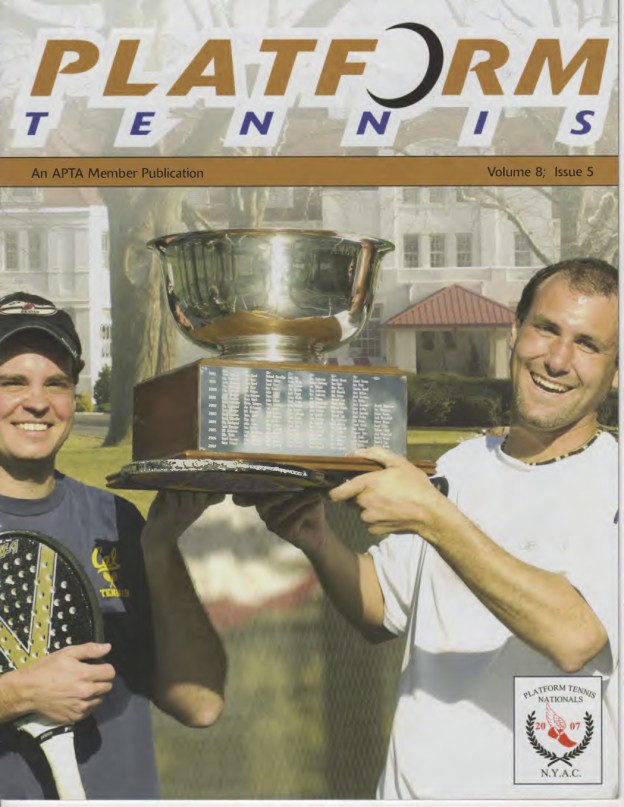
Nationals Chairman Bill Taubner and his staff of volunteers had nearly every angle covered for the week-long platform tennis festivities in Pelham, New York. In a word, the start of the Women’s Platform Tennis Nationals could be summed up as soggy. Rain plagued most of Friday, March 22, the first day of the competition. Despite the best efforts of the staff of the New York Athletic Club to dry courts in between showers, by 3 p.m., a substantial shower lasting a solid 40 minutes persisted.

A few games already in play were completed, but as the tired and cold players felt the usually crisp hits of the ball turn into a soggy, hard-tocontrol effort, spectators and fellow competitors drifted away to the dry confines of the clubhouse. There, they waited and hoped for the rain to subside enough for the New York Athletic Club staff to once again bring out the towels and push-blowers to dry the courts.

By 3:45, however, the rain let up enough for play to resume on the four heated lower courts at the NYAC.

There, the most major upset in the 2007 Women’s Nationals came after Heather Prop and Lynne Schneebeck, both of Cincinnati, defeated the number one team in the country (and 2006 National finalists) – Kerri Delmonico and Aila Main.

The pair said their strategy consisted of simply playing a lot of matches. “We played five matches in the President’s cup,” Prop said. “We tried to play the ball and our team, not our opponents.”

Schneebeck said her team’s strength comes from the fact that each player knows the other’s style. “(Prop’s) kind of quick. She’s got the spin,” Schneebeck said. “Today we were really focused.”

Prop and Schneebeck’s win took them to the Saturday morning semi-finals, where they were defeated by 3-time past Nationals Champions Mary Doten (Chicago) and Susie Keane (Detroit) 6-1, 6-1. To get to their semi-final, Doten and Keane defeated Bobo Delaney (New Jersey) and Tonia Mangan (New York) co-seeded as the #4 teams in the women’s draw, in the quarter-final, by a score of 6-2, 7-5.

The other semi-final pitted Cindy Prendergast (Delaware) and Lauren Zink (Lancaster, PA) against the third-seeded Chicago duo Sally Cottingham and Chris Sheldon. “We’ve trained hard and we’re focused;’ Cottingham said before the match. Prendergast and Zink responded in one of the most exciting matches of the women’s event, winning 6-3, 3-6, 6-3.

In the finals, Doten and Keane were challenged by the formidable Cindy Prendergast and Lauren Zink in a grueling match that was nearly a solid two-and-one-half hours of edge-of-your-seat platform tennis. Despite Lauren Zink’s cannon-like forehands and Prendergast’s solid backcourt performance, Doten and Keane proved once again that they are National Championship material and pulled the match out 6-2, 2-6, 7-5.

Doten, who left for the airport immediately following the match, said it helps to have three prior Nationals under your belt when you enter a court with this kind of competition. “You know that you can be down five games to four and still pull it out,” she said. “Lauren has a wicked forehand, and the toughest part is figuring out whether to hit it or get out of the way.”

Keane also said she felt the pressure of her competition’s groundstrokes. “The most difficult is the fact that Lauren’s forehand is scary. You feel a little rushed. Cindy is as solid as can be. We got a little lucky,” Keane said. “It could have gone either way. I’m glad it was such a good match. It was probably the best final we ever had.”

Keane said she has had to change her pre-nationals training to meet and overcome such competition. “Now that I live in Detroit, its not like Chicago. I kind of come out three weeks before Nationals and I cram with my friend Eva Welsher. We drill all day. I don’t have the games I used to have in Chicago.” Keane said that her drilling partner is definitely the key to her personal success.

The Men’s Nationals began on Saturday under threatening skies on a breezy 45 degree day. The 128-team draw saw few surprises in day one, as 14 of the 16 seeded teams advanced to the round-of-16, followed by 7 of the top 8 reaching the quarter-finals.

On Sunday, the rain gave way to a perfectly sunny, 50-degree day. Crowds swelled to more than 500 people to watch the semi-finals of the National Championships. To say the least, it was a perfect day for platform tennis at this historic club on the Long Island Sound. Sailboats meandered back and forth in the distance as the best players in the country took center court.

In the first semi-final, the top-seeded Baltimore team – David Caldwell and Blake Cordish played seven-time National Men’s Champions Flip Goodspeed and Scott Mansager. Starting at 10 a.m., the match extended past 1 pm. Goodspeed and Mansager used patience measured with calculated offense to defeat the more-aggressive Caldwell/Cordish.

The second semi-final featured four of the most exciting players on the tour. The second-seeded team of Dan Rothschild and John Schmitt fought hard against fourth seeds – Mike Cochrane and Scott Estes. Many thought the three-set battle was the best exhibition of the entire championship weekend with Cochrane and Estes prevailing.

The Men’s finals paired off Cochrane and Estes against Goodspeed and Mansager. Prior to the match, Goodspeed said his team’s strategy would consist of slowing down the aggressive Cochrane/Estes offense, but that strategy was offset early on in the match.

Cochrane/Estes won 6-3, 6-4 after an intense 2-hour finals battle.

“I feel they absolutely did try to slow us down,” Cochrane said after the win. “That was one of the reasons why I tried to create a faster pace. They tried to wait it out and we looked for good shots to make.”

Estes said the team strategy might have been different if they didn’t lead early in the match. “It would have been very different if we were behind,” he said. “We tried to stay ahead.”

The 2007 National finals was a first for Estes. Cochrane, however, played in the 2005 National finals.

Source: Platform Tennis News, Vol. 8, Issue 5, April, 2007