Rules on balls established

APTA started prescribing rules for use and specification of balls.

Ball Specification: The APTA furnished sponge rubber balls, approximately 2.5″ in diameter.

The Ball Use Rule: In tournaments, only one ball could be used continuously during each set. The server could not substitute another ball during an unfinished set without the permission of the tournament officials, nor could the server hold another ball when serving.

APTA focuses on foot-faults

For a number of years, the APTA had closed their eyes to the common issue of repeated foot faults, figuring that it might lessen the fun if they kept calling them. However, the Association began cracking down on them in championship tournaments, appointing foot-fault judges for final and semifinal matches.

Formal rules were introduced for the Men’s Championships in 1958.

Source: Adapted from Fessenden S. Blanchard, Platform Paddle Tennis, 1959

Let rule adopted for ball over the backstop

As play improved, balls were occasionally bounced over the 12-foot wiring, ending a rally and making it necessary to chase the ball for some distance. This was corrected when the APTA adopted a rule regarding balls bouncing over the backstop:

“A ball which lands in court of play and bounces up and over side or back walls should be considered a ‘let ball’ and the point replayed.”

Gates Sports Platform Company begins operations

Gates Court innovations

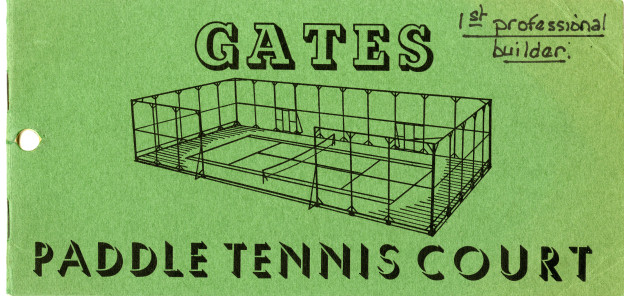
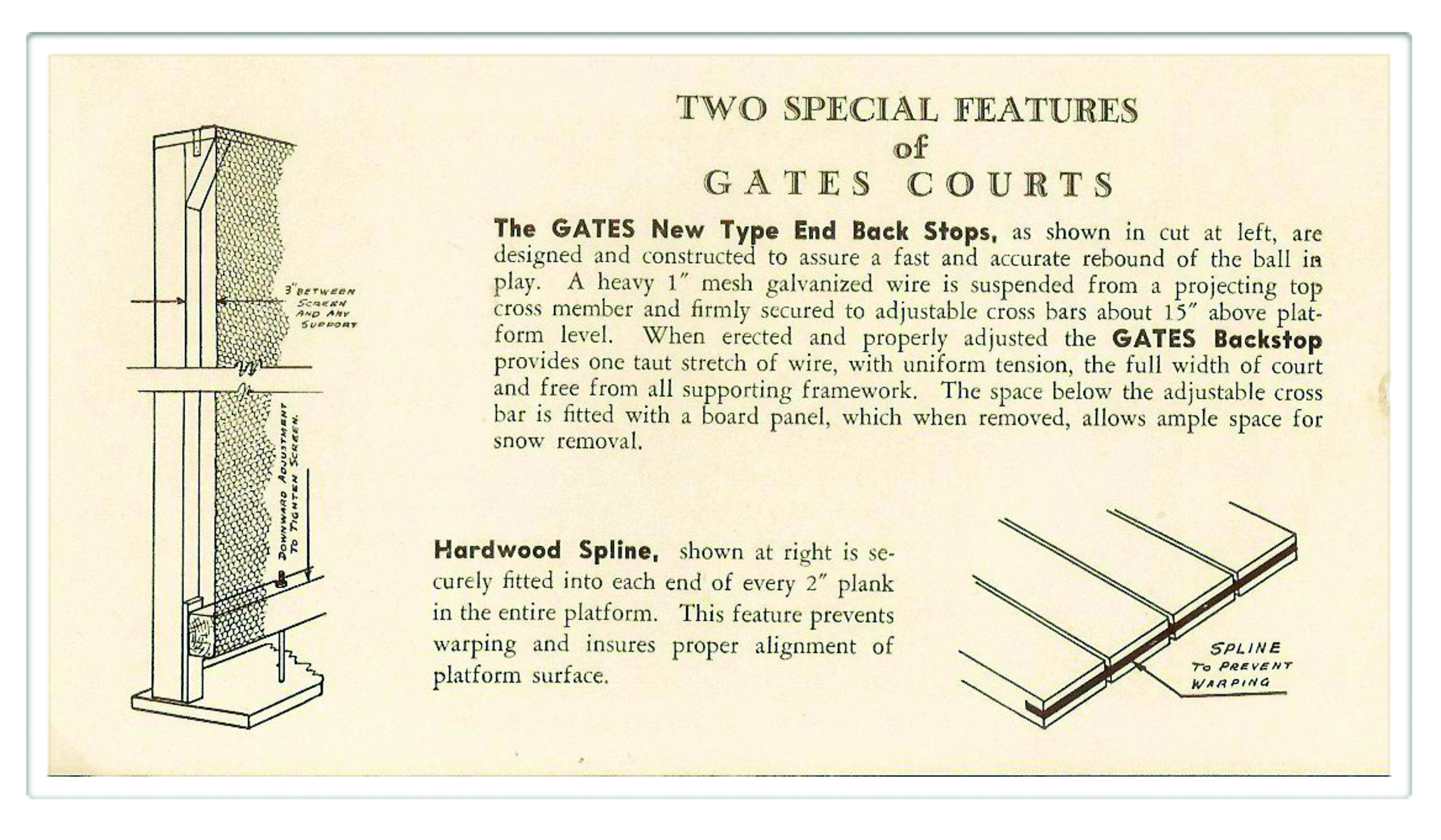
The early court construction had been greatly helped by the efforts of Henry B Eaton who was working for a lumber company in NYC. In the late 1930’s, the lumber company was liquidated, but fortunately the work Eaton had done in providing an easy and convenient way for clubs and individuals to obtain platforms inspired one of the company’s employees, Joseph Russhon, to take over its platform tennis business and he continued operations as the Gates Sports Platform Company.

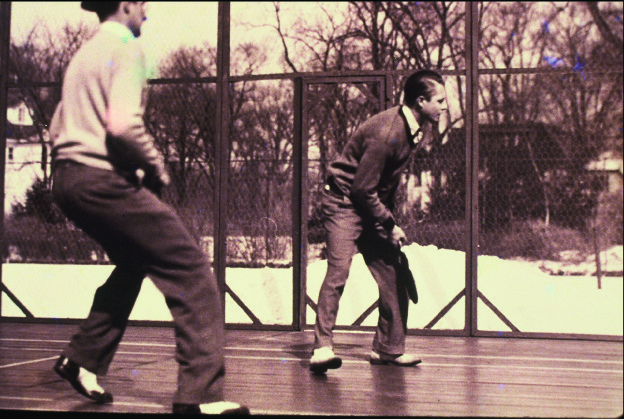
Thanks to Eaton and Russhon, the early development of the game received a considerable boost, and many platforms were set up. Some of these platforms were erected on top of tennis courts in the fall, and then taken down and stored in the spring. Later, clubs began to find it too expensive and hard on the platforms to put them down and take them up each year and permanent courts came to be the accepted practice.

Source: Adapted from Fessenden S. Blanchard, Platform Paddle Tennis, 1959

Historical Factoid: Eaton was President of Fox Meadow Tennis Club in 1936. His wife, Jean Eaton, was the winner of the Women’s Doubles and Singles Nationals in 1935 (the inaugural tournaments) and the Women’s Doubles in 1936.

Non-slip court surface developed

The members of the Tremont Place Paddle Tennis Club of Orange, NJ, developed the textured court. Sprinkling beach sand into the freshly painted deck before the paint dried produced the non-skid surface. When properly applied, the sand prevented both players and balls from skidding in wet conditions. The surface also eliminated glare from the reflection of a bright sun.

Source: Adapted from Fessenden S. Blanchard, Paddle Tennis, 1944

The APTA gave the following information to its members in its 1936 report:

“An improved court surface has been developed at the Tremont Place court in Orange, thanks to the research of Richard Grant, Herbert Pease and others.

This is accomplished by sprinkling about 40 pounds* of fine beach sand on the platform as it is painted and while the paint is wet.

This gives a less slippery surface, enabling the court to be played upon even when slightly damp or soon after a rain.

It also eliminates glare on a bright day. In view of the enthusiastic reports of our Orange members on this type of surface it is recommended for consideration of our other members when painting their courts in the fall.”

*Later revised to 100-180 pounds

Source: Fessenden S. Blanchard, Platform Paddle Tennis, 1959

Original version

The paddle evolves into the form used for almost the next four decades before innovations in the early 1970s; Jim Tate covers the history of the paddle through the early 1990s

In the early stages of the game, players used the lightweight, solid, rectangular shaped paddle (The Paddle Tennis Company’s standard paddle), but it was too light for a fast game.

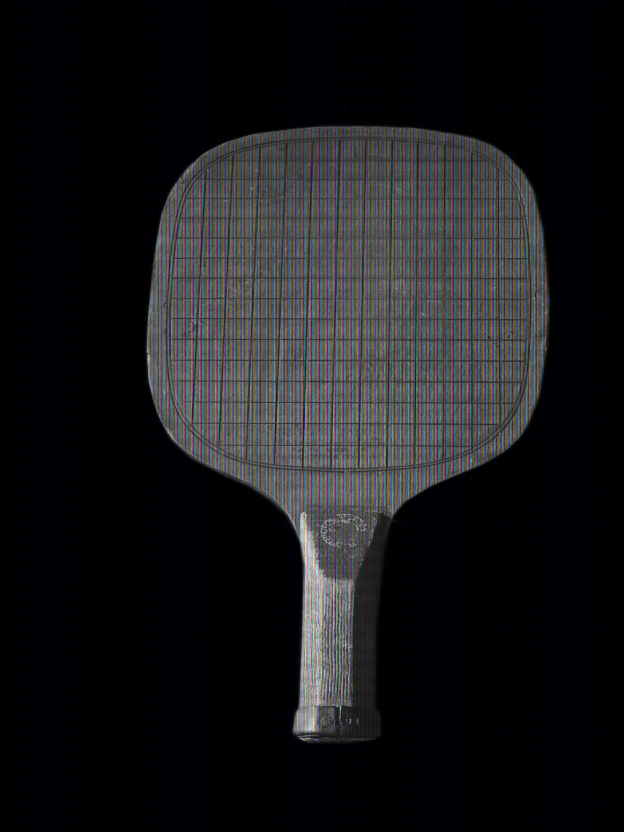
At the request of the Old Army Athletes The Paddle Tennis Company1 modified the shape of the paddle to a more oval design and added holes (the Tennette paddle) but this also proved to be too light and the edges tended to chip as there was no protective rim. A perforated, oval, mahogany stained paddle with a metal binding around its edges proved to be the answer and was first introduced in the late 1930s. It became the standard for the next four decades despite several efforts by the APTA to investigate better alternatives.

After the 1930s, the history of the paddle gets a little fuzzy. Apparently, the Reverend Frank Beal, who had invented playground paddle tennis, had a son who was living in the Scranton, Pennsylvania, area. This son met a local woodworker named Jankus, who could make paddles. Young Beal arranged to have Jankus produce paddles for both platform and paddle tennis. Reverend Beal would place an order through his son and Jankus would assemble them. Beal’s son would then load his car and head for Manhattan. It was a “catch as catch can” operation, according to Clint Sekol Jr., whose father bought the Dalton Manufacturing Company (the Jankus-Beal business) in 1950.

Source: Adapted from Fessenden S. Blanchard, Paddle Tennis, 1944, and Platform Paddle Tennis, 1959; and an article by Jim Tate in Platform Tennis News>and in the 1991 National Championship Tournament Brochure pp 18-19

In the 1970s and early 1980s new materials (fiberglass, foam composites, aluminum honeycomb,etc.) and construction techniques spurred a series of innovations which has continued unabated.

One of the most notable early innovations came in 1981 when Rich Maier, a multi-time APTA National Champion, formed Advanced Recreation Design with Andreas Schuler and introduced the Skymar paddle based on patent they had obtained.

Note 1: The Paddle Tennis Company was formed in 1922 by Rev Beal and Frank Contessa. It was sold in 1926 to the G. Lynn Sumner Company, a Madison Avenue advertising firm – see Frank B. Contessa

Source: Fessenden S. Blanchard, Paddle Tennis, 1944

Historical Factoid: Fessenden Blanchard on choice of serve or side: “Nails vs. No Nails: —By ‘nails or no nails’ we refer to the paddle tennis equivalent for ‘rough or smooth,’ when tossing up for choice of court or serve. Where the two leather ends come together, four tiny nails hold them. On the other side is one nail. The first side is ‘nails,’ the second, incorrectly, is ‘no nails’.”


From head to toe Killy Kilmarx and Kip Couch introduced a certain sartorial splendor to the game

Henry B Eaton develops inexpensive portable platform helping to grow the game

Fox Meadow Tennis Club member and former FMTC President (1936) Henry B Eaton, designed a collapsible platform that could be laid on an existing tennis court during the off-tennis season without damaging it. Eaton talked the New York lumber company company he worked for and the the forerunner of the Gates Sports Platform Company, to make the Eaton portable platform. The court was easy to transport and set up and only cost about $500, which made it affordable even during the Depression. These easy to install and cheap platforms were invaluable in growing the game.

Source: Adapted from Fessenden S. Blanchard, Platform Paddle Tennis, 1959

Historical Factoid: Eaton’s wife, Jean Eaton, was the winner of the Women’s Doubles and Singles Nationals in 1935 (the inaugural tournaments) and the Women’s Doubles in 1936.

Umpires Committee established

Prompted by increasing concern about line calls and foot-faulting, APTA President Robert Brown formed a committee to advise and recommend steps to cope with these matters. The committee recommended the establishment of an Umpires Committee, whose function would be to post line judges to make out calls and any foot-fault calls.

The APTA concurred with the recommendation. Paul Malloy, Paul Sullivan and Brook Kindred, from Fox Meadow formed the nucleus, along with renowned tennis umpires Jack Stahr and Mike Dunne.

Change to rule for ball over the screen

Previously, when a ball went over the screen, the point had been played as a let. Under the new rule, approved by the APTA Board in September, the striker lost the point outright.

The Board intended to evaluate the rule over the coming season to see if it should be confirmed or discarded.

It was later confirmed.

APTA addresses foot-faults

In order to discourage foot-faults, the partner of the receiver was now empowered to call them against the server. This experimental rule was based on a Jack Stahr “Decisions” column from the July 1973 issue of World Tennis. The intent of the APTA was to evaluate the rule over the coming season to see if it should be confirmed or discarded.

The appropriate section of this ruling was as follows:

Question: “…who is entitled to call foot-faults?”

Ruling: ” …..simply call a few of those services ‘faults’ under a broad interpretation of the official Explanation under Rule 8, which says that ‘it is customary for the Receiver to determine whether the service is good or a fault.’ (If it is illegally delivered, it is a fault.) This might not be the most sociable thing to do, but consider the unsociable effect that legal servers experience upon seeing their opponents take unfair advantage of them. ”