The Official Rules of Platform Tennis published

First Platform Tennis Rule Book published

Bill Ballard spearheaded this initiative with assistance from Bob Brown.

Prior to the publication of this book the guidance on platform tennis rules simply stated: “The rules of platform tennis are the same as for tennis except for the one serve rule and play off the wires etc.” The new Rule Book provided a comprehensive review of all the rules and regulations governing play.

The book was so well received that the first printing run of 6,000 copies quickly disappeared, necessitating a second printing in 1975.

The rules allowed a let to be played if a ball hit the crossbar, the angular beam between the side screen and the back screen which were standard on courts at the time. Eagle-eyed umpires who spotted an apparent ambiguity on this position involving Rules 2, 13, and 19, were informed that the overriding ruling was to be found at 13 (d), to wit, if the ball hits a crossbar, play a let.

The Rule Book also indicated that the standards for holes in paddles might be waived, so if a paddle didn’t have between 52 and 74 holes, that didn’t necessarily, make it illegal.

Sources: Off The Wire, Vol. 6 No. 1 and No. 3, and Robert A. Brown, personal communication
APTA’s ball standards revised

The APTA reported that all four of the approved ball suppliers met the new, tougher standards and that they now had their own testing capability, so if any balls became sub-standard during the season they could be “unapproved.”

The new balls were lighter and less bouncy and a yellow ball was approved for night play.

The approved suppliers were Barr, Vittert, Beconta, Inc. (a division of Puma), and Marcraft.

The APTA set forth the new ball standards:

I. BOUNCE TEST FOR REBOUND
Balls are conditioned at 70 degrees for 24 hours, then dropped from
90 inches to a concrete slab, and the rebound is measured.

Standard Rebound: 40 inches; Acceptable Tolerance: 38″ to 42″

II. WEIGHT TEST
Standard Weight: 72.5 Grams; Acceptable Tolerance: 70 to 75 grams

III. DIAMETER TEST
Measure diameter along two perpendicular axes of the ball. Both
readings must be within tolerance.

Standard Diameter: 2 ½” inches; Acceptable Tolerance: 2 ½” – 2 19/32″

Source: Off The Wire, Vol. 6 No. 1<.small>

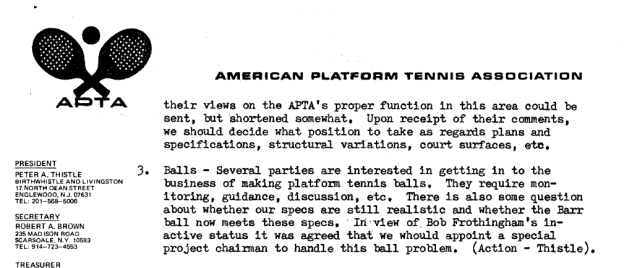
Ball draws criticism – more controversial than foot-faults!

The APTA Newsletter Off The Wire reported that the most controversial issue during the previous season (and that included foot-faults!) was the differences among the four APTA approved balls.

The article continued, “This one bounces too lively, that one warms up too slowly, the next one comes apart at the seams, etc. etc. etc. The Marcraft ball seems to have won high marks for playability, and some of the women’s tournaments actually publicized that ‘by popular demand’ the event was using Marcraft balls. Well, hold on to your prejudices, because we’re about to start a whole new ball game. Don Macrae, Grand Vizier of Equipment, has tightened up the specs for the coming season, and the manufacturers have all been advised to make a ball that is both lighter and less bouncy. Several of them have already submitted new batches for testing, and Don reports that the suppliers are being most cooperative.”

Source: Off The Wire, Mid-Summer 1974

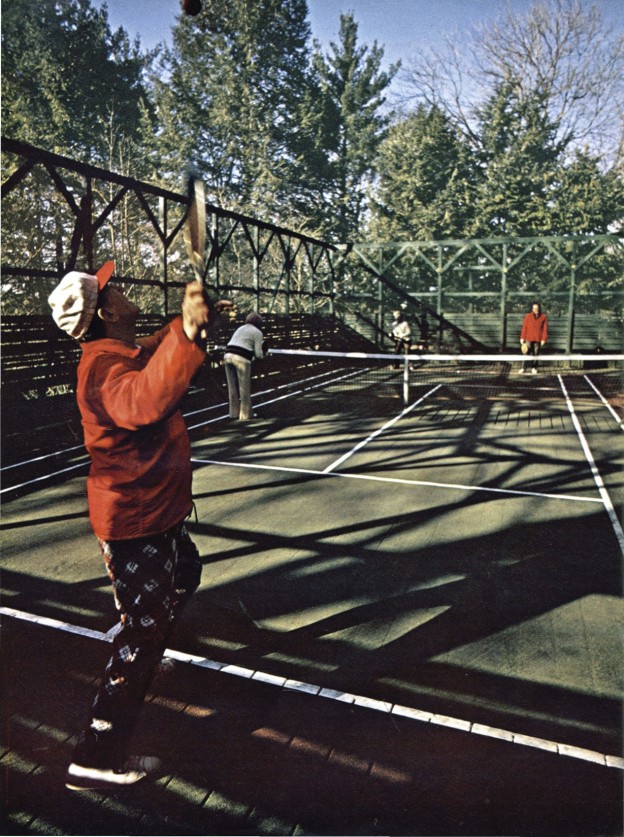
It’s not tennis, it’s not ping-pong, and its booming. Article written by John Ware for Travel & Leisure

APTA approves nine-point tiebreak

The tiebreak was to be played at 6-all. The APTA newsletter, Off The Wire, carried the details:

“1. The nine-point tiebreak is played when games reach 6-all.

2. The player whose turn it is to serve the next regular game is the first server. This is always the same player who started serving the set.

3. The team that wins 5 points is the winner of the set. The set is scored 7-6.

4. Each player must serve from the same end of the court in the tiebreak that he or she has served from during the set. (Note that this alters the sequence of serving by the partners on the second serving team.)

For illustration, with the serving team designated as Players A and B, and their opponents as C and D, the service order is as follows:

Points 1 & 2 are served by player A. Player A is always the player who started serving the set.

TEAMS DO NOT CHANGE COURTS

Points 3 & 4 are served by player D (out of normal sequence, but the
player who normally served from that end. )

Points 5 & 6 are served by player B.

Points 7 & 8 are served by player C.

Point 9 is served, if necessary, by player C, if the point score reaches 4-all. For this point only, the receiving team has the choice of receiving in either right or left court.

5. To begin the next set, “Stay for one” after the tiebreak. The team that did not serve first in the tiebreak serves first in the next set. Note that this rule continues to apply no matter how many sets in a match are decided by tiebreak.”

Source: Off The Wire, Vol. 5 No. 2

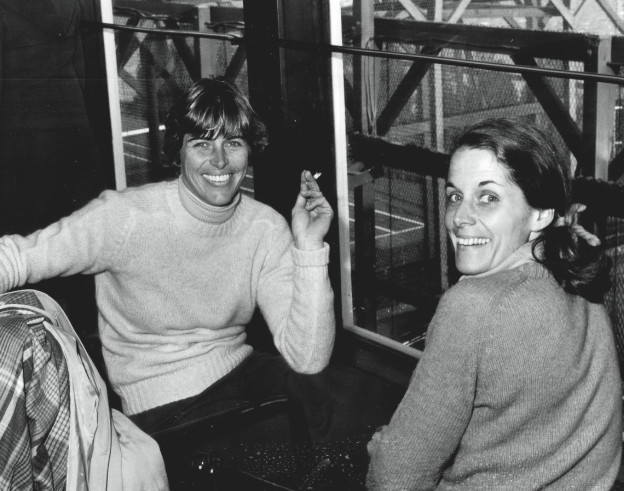
: Shirley Babington (left) and Marti Cavanaugh from Tenafly, New Jersey, won the Women’s Nationals in 1974. The sister team was runner-up in 1973, 1975, and 1977.

APTA takes position on use of tiebreak

The APTA newsletter, Off The Wire, reported on the APTA’s position on the tiebreak.

“The tiebreak is being used more and more in platform tennis tournaments. The APTA takes the following position on use of the tiebreak:

(1) For National Championships – The APTA will decide prior to each tournament whether the tiebreak will be used and, if so, for how many rounds.

(2) For all other Sanctioned Tournaments – The decision on whether to use the tiebreak or not is up to the tournament committee.

Where the tiebreak is used, the APTA recommended the nine-point tiebreak.”

Source: Off The Wire, Vol. 5 No. 2

The APTA gets serious about foot-faults

APTA reviews foot-fault rule

The rule was essentially the same as in tennis, but because of the shorter distance from baseline to net, and the higher premium on being at the net in paddle, foot-fault infractions were seen as more serious. The problem was two-fold: first, whether the statement of the rule itself should be revised; second, how to enforce the rule.

A seven-man working committee formed to cope with this rather controversial question. Chaired by Bob Brown, the committee consisted of Chuck Baird, John Beck, Brad Drowne, Bill Hoffmann, Paul Molloy, and Dick Squires.

In addition, the APTA called a 26-member Advisory Committee for the purpose of providing the broadest possible cross-section of views on this delicate matter.

The formation of the APTA’s Umpires Committee in 1974 was an outcome of the Working Committee’s deliberations.

Source: Off The Wire, Vol. 5 No 1

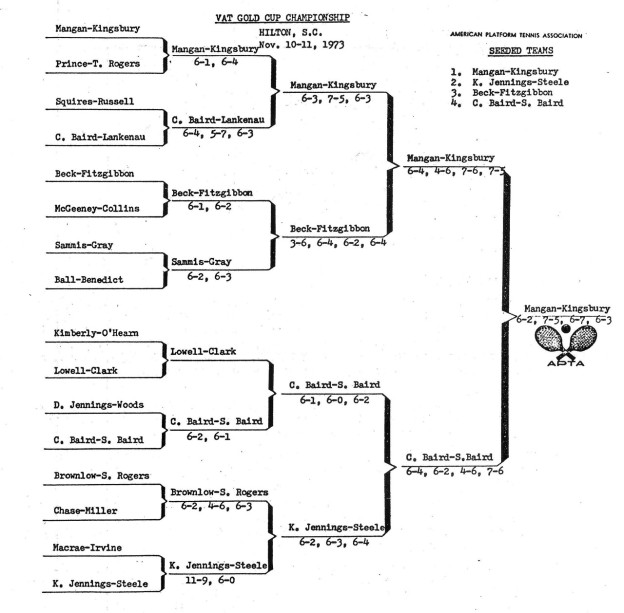
Tournament drawsheet and results

First APTA-sanctioned professional tournament – Vat Gold Cup International at Hilton Head – Kingsbury and Mangan win a thriller

Dick Squires organized the first truly commercial play-for-pay event. Sea Pines Plantation, in Hilton Head Island, SC, hosted the first Vat Gold Cup Invitational Tournament on November 10-11. It was also the first major platform tennis competition to be played in the Deep South.

The marketers of Vat 69 Gold, a brand of scotch whiskey, appreciated the demographic appeal of platform tennis enthusiasts. For the first time, top teams competed for money. The purse was $10,000, and “CBS Sports Spectacular” broadcasted highlights.

The New York Times covered the event in an article by Charles Friedman, entitled “And Now a Word for Platform Tennis” in the Sunday, November 18th edition.

For the event, the top sixteen men’s teams in the country were invited to participate. The offer included all-expense-paid travel, and the winners received a ten-day trip to Europe courtesy of National Distillers. Eleven of the top sixteen teams agreed to play, and Sea Pines built four courts just for the tournament. Bob Brown chaired the Championship match.

Although South Carolina can be warm during November, the weather cooperated. A cold front blanketed the area during the tournament, and the temperatures fell to as low as 35 degrees.

Bob Kingsbury and John Mangan won the tournament in an exciting four set final over Chip Baird and Steve Baird. Hundreds of spectators, many of whom were new to the sport, took in the final. The match has been described as one of the most thrilling ever, and Kingsbury and Mangan celebrated by being bathed in scotch.

The winning team received $3,000 for a trip to Europe.

Source: Off The Wire, Vol. 5 No. 1, and Charles Friedman, New York Times, November 18, 1973

APTA publishes “How to Conduct a Tournament Draw”

This booklet, authored by Robert A. Brown, included suggestions on the makeup of the draw committee; how to determine the byes and where to place them; how to seed and rank competitors; and how the seeds, and the other teams should be placed in the draw.

In the centerfold of the booklet, there was a sample draw that showed where each team would go. The procedure for conducting the draw was to be followed by all tournaments on the APTA Sanctioned Tournament Schedule.

Source: Off The Wire, Vol. 5 No 1

APTA looks into ball specifications

Ball quality had been a constant problem, and if anything, it seemed to get worse as time went on.
The APTA concluded that either suppliers were not making balls to its specifications, or the specifications themselves were incorrect.

The APTA invited sixteen top players to Fox Meadow to spend the day playing with balls in an organized testing program. Bob Brown and Amby Hardwick, who was the New Jersey Regional Vice President of the Association, chaired the project committee. Balls manufactured by Barr, Marcraft, Eagle Seamco and Robinson Bros. were tested and balls that met players’ approval were then further tested by the U. S. Testing Company so that they could draw up a set of specifications. Companies who met the specifications were issued approvals.

The APTA encouraged a number of manufacturers in the sporting goods field interested in making balls for platform tennis to develop prototypes and submit them for approval. The results were encouraging. The new balls lasted longer, played more consistently, and the velour-type flocking was a vast improvement and worth the increased cost. Among possible new developments were hollow balls, tested and deemed “interesting” by the test squad. A yellow colored ball, for higher visibility during night play, was also tested. All the manufacturers were told that the requirement for approval beyond the current season was the consistency of playing qualities.

In 1972, the Eagle Seamco (or Rubber) Company had submitted samples of yellow balls to the APTA that met ball specifications. They promoted the yellow coloring as having better visibility, especially at night. The balls were made available along with the traditional orange ball. Over the next two years, sales rapidly outgrew those of the orange ball and, by the end of 1974, orange balls were extinct.

The 1974 Nationals were the last ones to use the orange ball.

Source: The APTA Paddle Newsletter, Vol. 4 No. 4; Off The Wire, Vol. 5 No. 1; and Robert A. Brown, personal communication