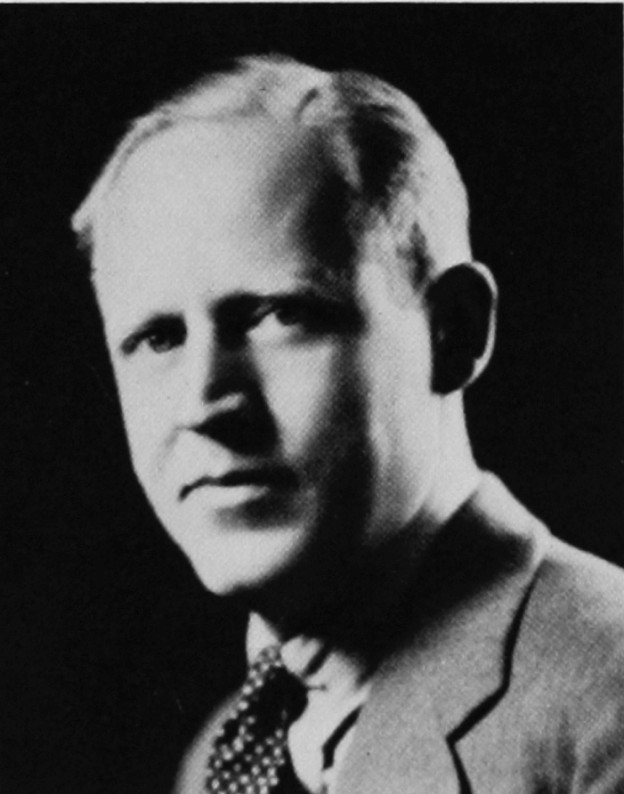
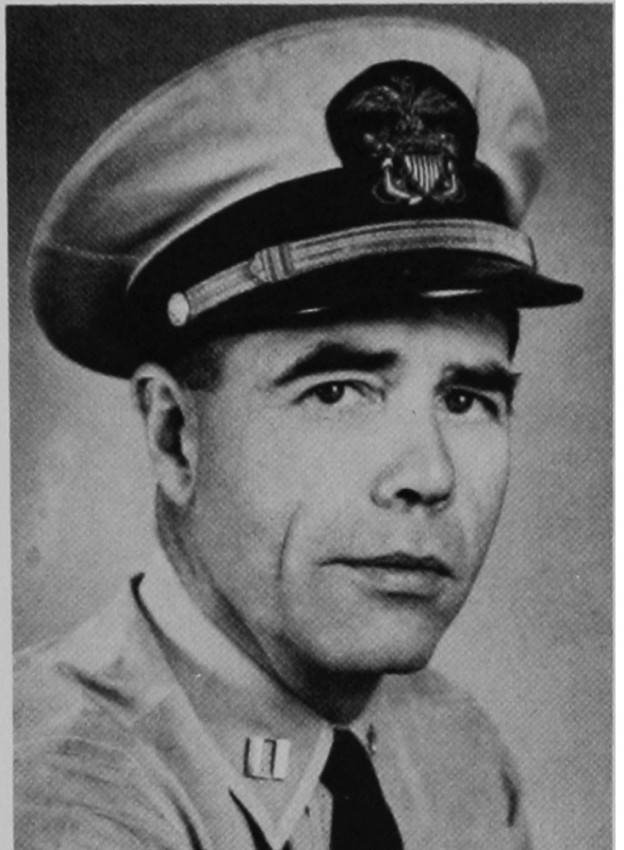
A. Keith Eaton, FMTC President (1940-1942)

A. Keith Eaton elected FMTC President (1940-1942)

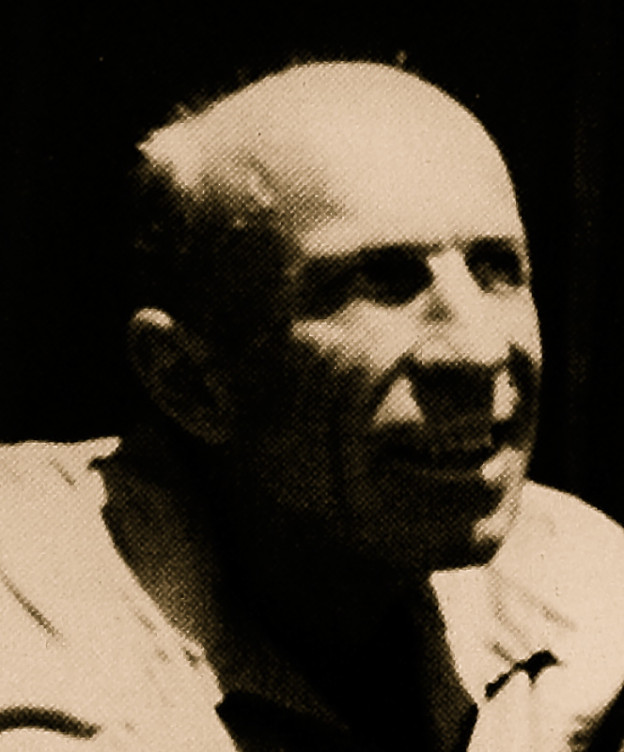
A Keith Eaton (1891-1975) was a graduate of Bowdoin College and retired from Shell in 1949 as assistant manager for national sales.

He had served in WWI as a flight instructor and as a colonel in the Army Corps of Engineers in WWII where he was in charge of the manufacture of the “Pluto” pipe lines that ran from England to France to supply the Allied armies with oil.

James K. Cogswell, FMTC President (1939-1940)

James K. Cogswell elected FMTC President (1939-1940)

Jimmy Cogswell (1893-1959) was a founder of the game of platform tennis along with Fess Blanchard.

Cogswell grew up in Portsmouth, ME and Blanchard in Boston, MA and both had different educational backgrounds and interests, but through an extraordinary lucky set of events they ended up as neighbors in Scarsdale, worked in the same business area, and had similar interests in finding something to do in the winter months.

The first court was built on the Cogswell property on Old Army Road and became a gathering point for a bunch of friends that called themselves the Old Army Athletes.

The story of how the game grew from this court, rescued FMTC from bankruptcy and now is played by over 40,000 enthusiasts throughout the county is rich with the seminal contributions of many FMTC members over many decades.

National Championships

1939

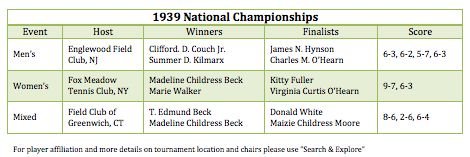
Fox Meadow Teams again dominated the tournaments and were winners and finalists in the three events.

Couch and Kilmarx repeated their 1935 win by defeating Hyson and O’Hearn who had won the previous two years and Madge Beck and Marie Walker successfully defended their 1938 title and were on their way to five straight wins until the war years when the event was discontinued from 1943-1948.

Source: Fessenden S. Blanchard, Paddle Tennis, 1944

1938 Memorial Day Carnival at Fox Meadow

Strong social aspect at Fox Meadow

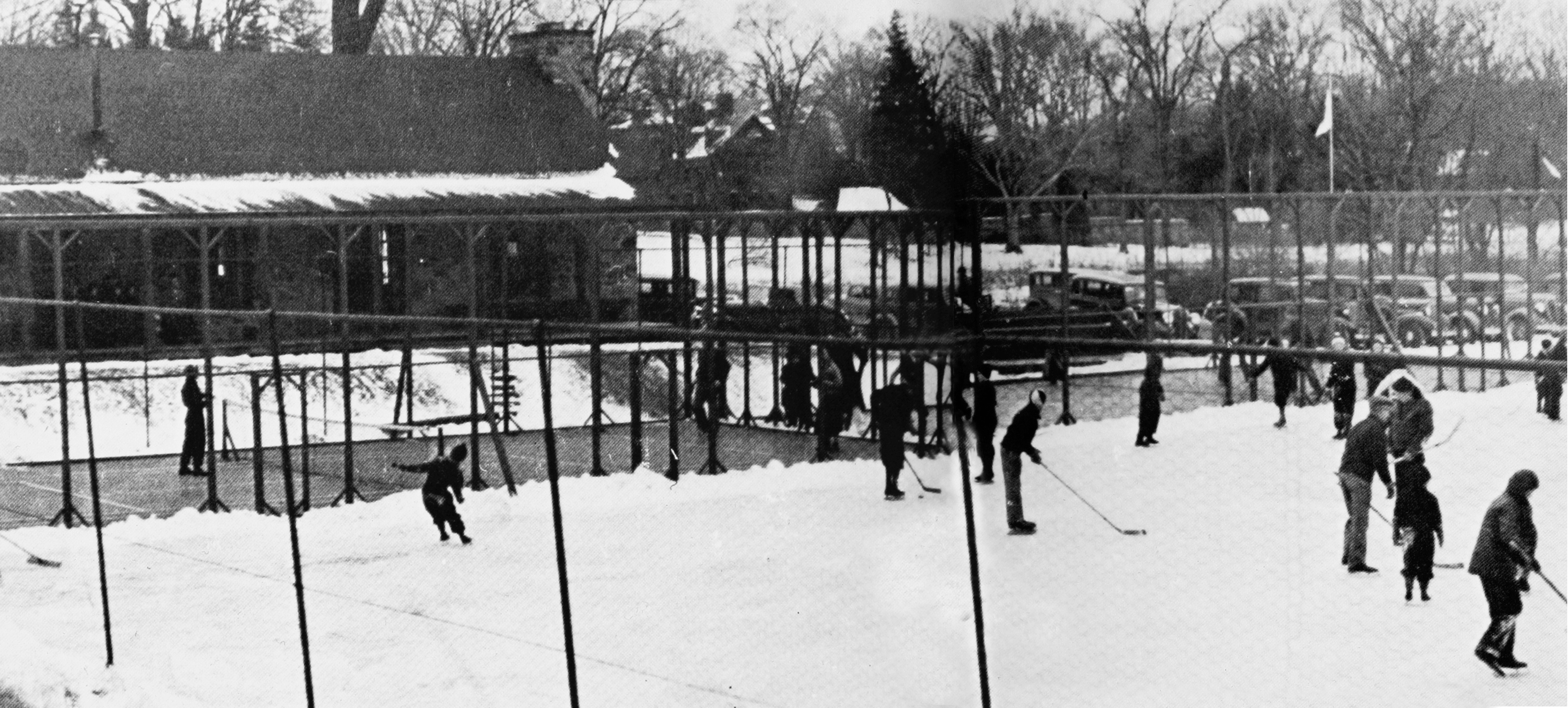
A busy day at Fox Meadow in the early 1940s. Platform tennis, hockey and skating keep members out of mischief. A busy day at Fox Meadow in the early 1940s. Platform tennis, hockey and skating keep members out of mischief.

In 1938, FMTC held a Memorial Day Carnival, complete with a Fox Meadow orchestra directed by Woodruff Johnson and made up of members: on piano, Johnson; on saxophone, Putnam Livingston; on guitar, Earle Gatchell; on banjo, Allison Scully; and on violin, Wardwell Proctor.

Two reasons were given for staging the carnival: to provide a good time for families and to raise money for a Club Improvement Fund. The carnival raised $333. That was Fox Meadow Tennis Club: fun, practical, and frugal. When something needed to be done, more often than not, members would do it themselves. Dues remained low because of members’ willingness to pitch in.

The master of ceremonies was Thorndike Deland, Sr. For a ten-cent admission charge one could also watch him perform magic tricks. The gypsy cranking a rented hurdy-gurdy was Club President John Van Norden. His tunes enlivened all the attractions a carnival should have: a fortune-teller, games of chance, a marionette show, and a shooting gallery where Jim Hynson proved deadly accurate with water pistols, dousing candles as fast as volunteers could relight them.

Source: Diana Reische, Fox Meadow Tennis Club – The First Hundred Years, 1983

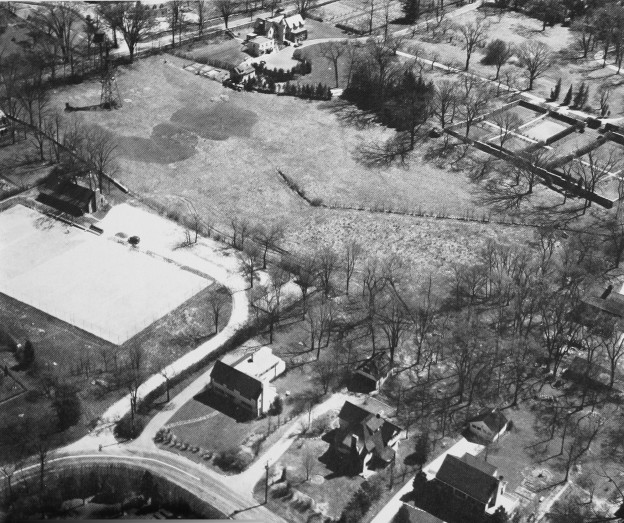
Aerial view of FMTC in 1937. At the left stands the windmill in Crane Meadow, just below Church Lane. The first paddle court can be seen at the curve of the driveway.

Effort to gain control over the Tennis Realty Corporation

Before Fox Meadow could make any substantial changes—buy or sell property, expand the clubhouse—it first had to gain operating control of the old Tennis Realty Corporation, which owned the Club’s grounds and facilities. This wearisome task took more than a decade.

By the early 1930s, so many former members (and therefore stockholders) had resigned, moved, or died that Club members owned a shrinking percentage of the Realty Corporation’s stock. It had become impossible to assemble a quorum for the annual meeting of the Realty Corporation, a situation that left its directors in a legally untenable situation.

In 1937, during John Van Norden’s presidency, the Club board began an all-out effort to collect enough stock through donation, purchase, or affidavits stating that the shares were lost, to gain control of the Realty Corporation and then liquidate it. After years of persistent effort, the Realty Corporation was dissolved in 1941. Fox Meadow Tennis Club assumed its property and its mortgages. Since then the management of the Club has rested solely with the Board of Governors.

Source: Diana Reische, Fox Meadow Tennis Club – The First Hundred Years, 1983

Madge Beck and daughter, Susan Beck Wasch (Honor Award 1976).

The Childress tennis and paddle dynasty

The first of this racquet dynasty at the Club were Avent and Madeline Childress. Mrs. Childress taught all four of her daughters to play tennis, and three of them loved the game. When the girls were introduced to paddle, they took to the game like a trio of naturals. All three became national champions: Sally Childress Auxford, Madge Childress Beck, and Maizie Childress Moore.

For decades, the family’s daughters and grandchildren formed a nearly unbeatable paddle dynasty, with a string of APTA National Championships stretching from 1936 to 1974. Sally Childress, a frequent women’s tennis champ at the Club, took her first national paddle tournament in 1937. Her partner was her sister Maizie. Nearly twenty years later Sally Childress Auxford captured a second Women’s Doubles title, with partner Barbara Koegel, and in 1959 she won the Mixed Doubles crown.

Although each of the Childress women was formidable on the court, the unfailing powerhouse was Madge Beck, who won an incredible seventeen national championships: twelve Women’s Doubles, four Mixed Doubles, and one Women’s Singles. Most consider her to be the game’s all-time best female player, and her record has never been duplicated. Famed for her terrifying backhand and aggressive play, she might have won even more tournaments had they not been canceled during World War II. For her first national championship, Madge Beck teamed with Club member Marie Walker, but in 1949, she began playing with her sister Maizie Moore, and the pair did not lose a single set for several years. Top-seeded nationally year after year, the sisters won the Women’s Doubles title five times between 1949 and 1954, and thirteen times with other partners.

Both Madge and Maizie were inducted into the Platform Tennis Hall of Fame in 1965 and 1970 respectively.

In club platform tennis championships Madge won five Women’s – 1952-1953, and 1956-1958, twice with Maizie and three times with Sally. In Mixed she won seven straight titles – 1943-1950, five of them with her husband. Sally won eight Women’s titles from 1954 through 1971 and one Mixed in 1966 with her husband Peyton. Maizie won three straight Women’s – 1952-1954.

In club tennis championships Sally won eight Singles titles during the period 1952-1972, seven Doubles titles from 1953-1973, and one Mixed Doubles in 1956. Maizie won one Singles in 1954, one Doubles in 1949, and two Mixed in 1942 and 1953, both with her husband. Madge won five Doubles titles- 1950-1952, 1954, and 1959.{Note: Astonishingly the first documented Women’s Singles and Doubles championships was in 1948 although the Scarsdale Inquirer mentions women who won tournaments in the 1923-1931 time-frame]

Source: Diana Reische, Fox Meadow Tennis Club – The First Hundred Years, 1983

Tea after paddle at Fox Meadow

This tradition began when the Cogswells arrived at FMTC with the Old Army Athletes in the 1930s.

Families took turns serving tea, cinnamon toast, and cookies. In 1936, fifteen cents entitled a member to “unlimited tea, toast, and condiments.” (see sidebar article)

So popular were the Saturday teas that they were extended to Sundays, and iced tea was served during tennis season.

It was not until the 1970s that the Sunday teas were discontinued.

Source: Diana Reische, Fox Meadow Tennis Club – The First Hundred Years, 1983

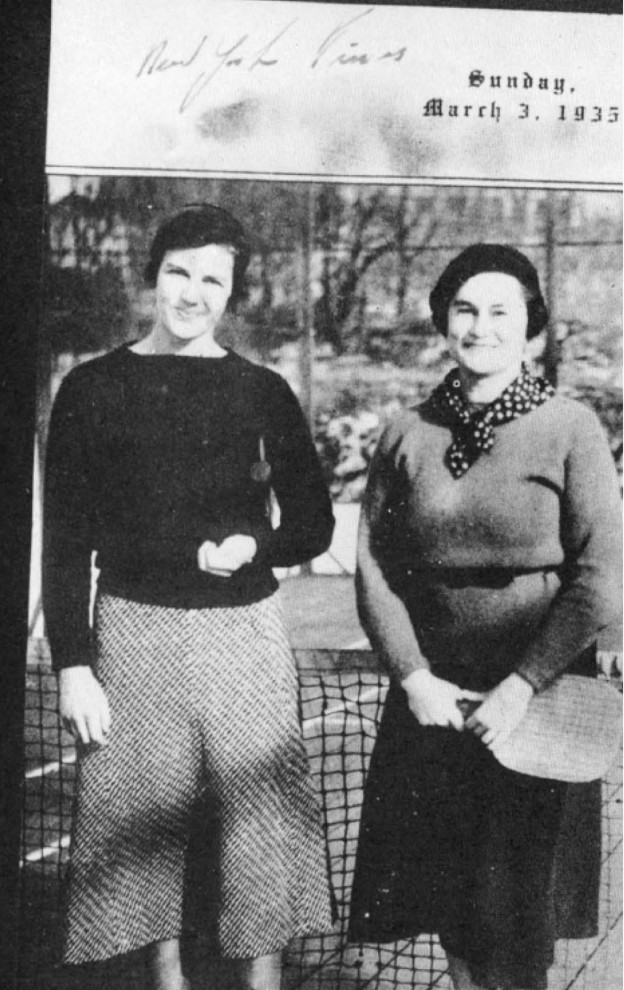
Jean Eaton and Kitty Fuller, the 1935 and 1936 Women’s Champions dressed for paddle

Game spans the generations and skill levels at Fox Meadow

At Fox Meadow, paddle meant not just championship competition, but the inclusion of young and old, good and mediocre. This was an aspect of the sport fostered by the Old Army Athletes. From the time a youngster was old enough to get a ball across the paddle net, she or he was included, not just in Juniors play, but in some Club tournaments as well.

And Fox Meadow held a lot of tournaments: Men’s and Women’s Doubles, Singles, Mixed Doubles, Girls’, Boys’, Round Robins, Scrambles. On a single 1935 weekend, the Club held a Men’s Doubles, a Junior Boys’ Singles, and a Junior Girls’ Singles. In some of these, quite young players had a chance to face the game’s best competitors. In the winter of 1935, Ruthie Blanchard, age twelve, partnered her father to the finals of a Club championship Mixed Doubles. The Blanchards lost, but the pair across the net were Percival and Kitty Fuller, and Kitty Fuller happened to be the National Women’s champion that year.

Source: Diana Reische, Fox Meadow Tennis Club – The First Hundred Years, 1983